
It’s Monday morning. A lead came in over the weekend through the website form.
The form tool emailed it to an inbox nobody checks on Sundays. The CRM never got it. The AI chatbot answered the same person with a price you stopped offering in August.
Three tools. Three versions of the truth. One lost customer.
That’s what a bad AI and automation stack looks like in real life. Not a dramatic hack. Just a bunch of good apps that were never designed to work together.
Some links in this article are affiliate links. If you buy through them, we may earn a commission at no extra cost to you.



This one’s for you if you run a small business or a side hustle and your “system” is really eleven subscriptions, three logins on sticky notes and a ChatGPT tab that knows more about your customers than your CRM does. I went through the research on tool sprawl, SaaS waste, AI project failure and breach costs. Then I lined it up against the way One Big Media Company (OBMC) says it plans this kind of work on its own site. Full disclosure: OBMC lists The American Side Hustle as one of its brands, so read this as a builder explaining a method, not a neutral review. I’m only using what OBMC actually publishes, and numbers I could check.
Short version, so you remember it: Fewer tools. Clear owners.

Here’s what’s going on with the AI and automation stack
Three trends are colliding: more software, more AI tools than anyone connects, and a bill that shows up as waste, stalled projects and security holes.
Small businesses are stacking tools fast
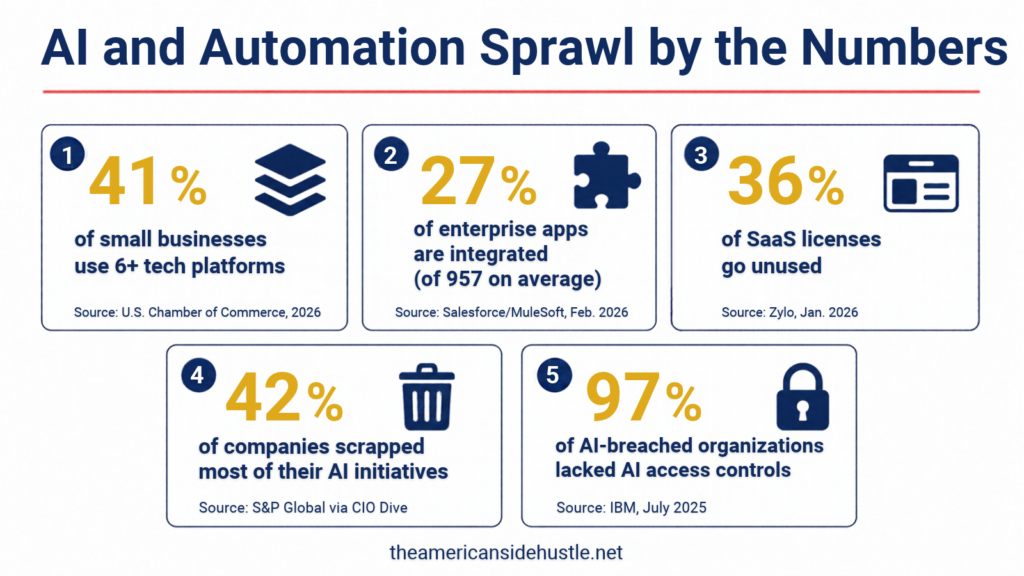
The U.S. Chamber of Commerce’s 2026 Empowering Small Business report, built on a Teneo Research survey of 3,732 small businesses this summer, found that 41% now use six or more technology platforms, up from 14% in 2022. Two-thirds (66%) say they use AI, up from 58% in 2025 and 23% in 2023. And 64% rely mostly or entirely on AI tools built by other companies, while only 8% build their own.
Now here’s the twist. The Census Bureau’s Business Trends and Outlook Survey puts national business AI use at just 19.8% as of May 3, 2026, and says use among firms with fewer than 20 employees didn’t change significantly over the winter and spring, according to a Census story from May 26. Why the gap? The St. Louis Fed explained in June that wording moves these numbers a lot. When Census broadened its question in November 2025, the measured rate nearly doubled to 17%.
My read: lots of owners have a chatbot open. Far fewer have AI built into how the business runs.
The tools multiply. The connections don’t.
Bigger companies show where this goes. Salesforce’s 2026 Connectivity Benchmark, a survey of 1,050 IT leaders, found the average enterprise now runs 957 applications, and only 27% of them are integrated. Half of their AI agents operate in isolated silos, and 86% of leaders worry agents will add more complexity than value without integration.
Zapier’s own AI sprawl survey of 550 U.S. executives found 70% haven’t moved beyond basic integration for their AI tools, 28% use more than 10 AI apps, and only 35% say those tools go through proper approval. And 76% have had at least one negative outcome from disconnected AI. “Tool sprawl is the natural outcome of rapid AI adoption,” said Zapier AI automation engineer Emily Mabie, per the company’s Dec. 3 press release. Fair warning: Zapier sells orchestration software, so it has a horse in this race.
The money leaks quietly
Zylo’s 2026 SaaS Management Index, released Jan. 29, found organizations leave 36% of their SaaS licenses unused. Spending on AI-native apps jumped 108% in a year, expense-based SaaS spend (software bought on a card, outside IT) grew 267%, and ChatGPT is now the most expensed app. Business units, not IT, control 81% of SaaS spend. “AI is quickly becoming the most expensive ‘invisible worker’ in the organization,” said Zylo co-founder Ben Pippenger.
In a small business, there is no IT department to lose control. There’s you, a card on file, and a pile of free trials that turned into renewals.
Most AI projects stall, and the model usually isn’t why
MIT’s NANDA initiative found only about 5% of generative AI pilots reach rapid revenue acceleration, according to Fortune’s report on the study. The lead author blamed a “learning gap” between the tools and real workflows, not model quality. The biggest returns showed up in back-office automation, not flashy sales and marketing tools.
S&P Global Market Intelligence found 42% of companies scrapped most of their AI initiatives, up from 17% a year earlier, and the average organization dropped 46% of its proofs of concept before production, CIO Dive reported. Cost, data privacy and security were the top obstacles.
The security bill shows up last
IBM’s 2025 Cost of a Data Breach report found 13% of organizations had breaches of AI models or apps, and 97% of those lacked proper AI access controls. One in five reported a breach tied to shadow AI (tools employees use without approval), and heavy shadow AI added about $670,000 to the average breach, according to IBM’s announcement. “AI security must be treated as foundational,” said IBM’s Suja Viswesan.
Verizon’s 2026 Data Breach Investigations Report says a third party was involved in 48% of breaches, and frequent employee use of AI tools jumped from 15% to 45% in a year, per Verizon’s summary. In the 2025 edition, IDC’s Craig Robinson noted ransomware was present in 88% of breaches at organizations without mature IT and security, which often means small businesses, according to Verizon’s 2025 release.
| What was measured | Finding | Source |
|---|---|---|
| Small businesses using 6+ tech platforms | 41% (14% in 2022) | U.S. Chamber / Teneo, 2026 |
| Enterprise apps that are integrated | 27% of 957 | Salesforce/MuleSoft, Feb. 2026 |
| Execs past basic AI integration | Only 30% (70% are not) | Zapier / Centiment, Oct. 2025 |
| SaaS licenses left unused | 36% | Zylo, Jan. 2026 |
| Companies scrapping most AI initiatives | 42% (up from 17%) | S&P Global via CIO Dive |
| AI-breached orgs lacking AI access controls | 97% | IBM, July 2025 |
| Breaches involving a third party | 48% | Verizon DBIR, May 2026 |
Sources: U.S. Chamber of Commerce, Salesforce, Zapier, Zylo, CIO Dive/S&P Global, IBM, Verizon. Surveys use different samples and company sizes, so compare them with care.
Read that table as one sentence: buying tools is easy, connecting and owning them is the hard part.
The OBMC playbook: mission first, architecture second, tools third
This is where planning beats shopping. One Big Media Company describes itself as “Media + AI + Automation + Infrastructure” and says it tries to “connect the work instead of stacking disconnected vendors.” Its About page puts the order bluntly: “Mission first. Architecture second. Tools third.” Here’s how the rest of the site turns that into a method.
Discover the real constraint. The About page explains why: “A media problem can expose a website problem. A website problem can expose a CRM problem.” The home page FAQ says discovery is meant to find “the smallest responsible combination of services.” Smallest. That’s the opposite of a tool stack.
Design the connected system. OBMC’s insight piece, “You Need Fewer Disconnected Systems, Not More Software,” has the line every owner should tape to the monitor: “Staff become the integration layer.” Its fix isn’t one giant app. “A connected operation does not require one giant application. It requires deliberate boundaries.” The CRM owns contacts. Accounting owns invoices. The order is remove, standardize, connect, then automate.
Rules before intelligence. On AI, the site’s sequence is “Process first. Simplify second. Standardize third. Automate stable rules fourth. Add intelligence where variability justifies it.” It also warns that “every month spent testing disconnected AI tools creates more prompts, subscriptions, and risk without creating a dependable operating system.”
Build, verify, transfer. The home page promises to “ship in testable phases with documentation and a clear path for your team,” and contrasts “Launch ends the project” with “Verification starts at launch.” The infrastructure page admits what most owners won’t: “Backups exist in name but have not been restored and verified.” Its process ends with Verify and Transfer.
What the site doesn’t say matters too. No client results, no revenue, no team headcount, no guaranteed outcomes. In its own words: “No responsible agency can guarantee results it does not fully control.” So I’m not implying any.
Here’s my take on building an AI and automation stack
Tool sprawl isn’t a character flaw. It’s what happens when you’re busy. Something breaks, you find an app, you move on. Do that for two years and you’ve built a machine nobody designed.
OBMC’s insight article says it better than I can: “The subscription cost is visible. The operating cost is not.” The operating cost is you, at 10 p.m., copying a lead from the form tool into the CRM because the connector broke and you didn’t know.
- More AI tools is not more AI. The Chamber says 66% of small businesses use AI. Census says about one in five. The gap is “I have a chatbot” versus “AI is wired into how leads and bookings move.” Only the second one pays.
- Boring wins. MIT found the best ROI in back-office automation. OBMC says “the first automation should be boring and valuable.” Confirming appointments and routing leads won’t go viral. It will get you paid.
- Every vendor is a door. With third parties in 48% of breaches, each extra app holding customer data is one more door to lock. Fewer doors, fewer locks.
And yes, the self-aware part: we built The American Side Hustle as an all-in-one toolkit, so of course I like consolidation. But even if you never touch our stuff, the principle holds. Pick a hub. Give every job one owner. Make the rest earn their spot.

What an AI and automation stack actually costs
The good news: a connected stack for a small business isn’t expensive. The Chamber found the median small business paying for AI spends $250 a month, and 41% use free AI tools. Here’s what the core pieces cost on the official pages today.
- A hub (CRM, funnels, follow-up in one place): GoHighLevel Starter is $97 a month with up to three sub-accounts (client accounts), and Unlimited is $297. Both include unlimited contacts and users and a 14-day free trial. I covered the platform in depth in what GoHighLevel is and how to sell automation with it.
- Glue between apps: Zapier is free for 100 tasks a month with two-step Zaps. Professional is $29.99 a month (or $19.99 a month billed yearly) for 750 tasks.
- Self-hosted automation: If you’d rather own the engine, Hostinger’s KVM 2 VPS is $8.79 a month on a 24-month term ($210.96 upfront), renewing at $14.99, with n8n as a one-click install. Cheaper, but now the backups and updates are your job.
The real cost isn’t on any pricing page. It’s unused licenses plus the hours you spend as the integration layer.
How I’d play it
If I were planning a small business AI and automation stack from scratch, here’s the order I’d follow. It’s OBMC’s discover, design, build, verify, transfer path, sized for a one- or five-person shop.
Step one: inventory everything before you buy anything. List every app, login, domain, inbox, spreadsheet and AI tool the business touches. Who pays? Who’s the admin? Can you export the data? OBMC’s infrastructure page calls out “domains, hosting, DNS, email, certificates, and applications” with “unclear ownership.” Find those now, not during an outage.
Step two: map one journey end to end. Pick the one that makes money, usually lead to booked to paid. Write each step, which system holds the record, and who owns it. Every place someone copies information by hand is a gap. If missed calls and slow replies are your leak, my guide to automating missed calls, texts and booking walks through that exact journey.
Step three: cut before you connect. OBMC’s first question is “Should this step exist?” Kill the duplicate approval, the form field nobody reads, the report nobody opens.
Step four: choose a hub and draw the boundaries. One system owns contacts and pipeline. One owns money. One owns files. Everything else either feeds the hub or goes.
Step five: automate one boring rule. One source, one event, one owner, one measurable outcome, the way OBMC’s pilot advice puts it. Write down the manual baseline first: how many leads a week, how long replies take. Then test duplicates and after-hours cases. If you’re weighing agent tools for this, I compared them in no-code AI agent builders and what to automate first.
Step six: add AI only where inputs vary. Sorting messy inquiries, summarizing calls, drafting replies for a human to approve. Keep a person on anything involving money, complaints or promises to customers. Set a data rule, too: what never goes into an AI tool. NIST’s voluntary AI Risk Management Framework is a solid free reference if you want the formal version.
Step seven: verify, document, transfer. Restore a backup on purpose. Turn on multi-factor authentication everywhere and remove old employees’ access, as the SBA’s cybersecurity guide recommends. Then write a one-page map of what talks to what, so the business doesn’t live in one person’s head.
Watch-outs
Silent failures are the worst failures. OBMC warns that “a broken manual process is visible. A broken automation can quietly affect hundreds of records.” Set an alert for every automation that matters, and check the receiving system, not just a green checkmark in the builder.
Consolidation can become lock-in. One hub is great until you can’t leave it. Before you commit, confirm you can export contacts, conversations and files. “Own what matters,” as OBMC’s principles say, means access, knowledge and data, not just a login.
Watch the promo pricing. Intro rates expire. Zylo found 78% of IT leaders got hit with unexpected consumption or AI pricing charges in the past year. Calendar your renewals.
Be skeptical of vendor surveys, including the ones I quoted. Zapier, Salesforce and Zylo all sell solutions to the problems their surveys describe. The direction of the data is consistent, but treat any single number as a signal, not gospel.
Quick answers
Should I build custom software instead? Usually not first. MIT found buying from specialized vendors succeeded about twice as often as internal builds. If you do have a real product idea, my small studio playbook for building a digital product covers that path.
Is this a business opportunity, too? Yes. Plenty of owners know they need this and can’t do it themselves. I wrote about that in the small business AI setup gap.
The bottom line
The data lines up. Tools pile up, most AI isn’t connected, many AI projects get scrapped, and every extra vendor is another way in. Buying the next app fixes none of it.
Planning fixes it: find the real constraint, design the connected system, build in small tested pieces, verify, and document. That’s the order One Big Media Company publishes, and the one I’d follow.
Fewer tools. Clear owners. That’s the play.
And if you’d rather start with the funnel, follow-up and payments already living in one place, that’s what we put together at The American Side Hustle. One hub, fewer logins, more time back for the people you love. Earn in USD. Live anywhere.
Tools I’d use for this
- GoHighLevel: one hub for CRM, funnels, texts, email and booking, so fewer apps need to talk to each other.
- Hostinger VPS: a low-cost server with one-click n8n if you want to own your automation engine (you handle the backups).
- Hostinger Business Email: email on your own domain, so customer conversations aren’t tied to a personal inbox.
Some of these are affiliate links. If you sign up through them we may earn a commission, at no extra cost to you. See all our picks on the Recommended Tools page.
Photos: Ivan S, Christina Morillo and Dan Nelson on Pexels. Graphics: The American Side Hustle. Prices checked on official pages Nov. 24, 2026, and may change.
Ready to build your own American side hustle?
Get funnels, automated follow-up, text-to-pay and courses in one dashboard. Earn in USD, live anywhere.