It’s a Tuesday night in late November. You just got paid for a client project, and you’re moving 25% of it into a savings account labeled “TAXES” like you always do.
Same number as last year. Same habit. Same guess.
Here’s the thing. The IRS just set the 2027 tax brackets and changed the math for next year, and most people with side income won’t look at it until April 2028. By then, it’s too late to plan.
Some links in this article are affiliate links. If you buy through them, we may earn a commission at no extra cost to you.
This one’s for you if you earn money outside a W-2 paycheck: freelance work, a weekend gig, a small online store, a YouTube channel, consulting on the side. The 2027 tax brackets, the new retirement limits and the new Social Security wage base all came out in the last few weeks. I went through the IRS releases, the actual Revenue Procedure and IRS Notice PDFs, the Social Security numbers and the newest side hustle data. Here’s what changed, what didn’t, and what I’d do with it before the year turns.


Keep this line in your head: New numbers. New plan.

Here’s what’s going on with the 2027 tax brackets
Quick note on scope. If you’re trying to lower your 2026 bill before Dec. 31, start with my year-end tax moves for freelancers. This piece looks one year ahead: the numbers you’ll live with from January 1, 2027, on.
The brackets moved up about 3.2%
On Nov. 5, the IRS released its tax year 2027 inflation adjustments in news release IR-2026-133, covering dozens of provisions. The key line from the IRS announcement: the 2027 adjustments “generally apply to tax returns filed in 2028.” So this is the money you earn next year.
The seven rates stay the same, from 10% to 37%. What moves is where each one starts. For a single filer, the 22% bracket now starts above $52,025 of taxable income, up from $50,400 in 2026, per the IRS’s 2026 release. The 24% bracket starts above $109,125, up from $105,700. For married couples filing jointly, 22% starts above $104,050 and 24% above $218,250.
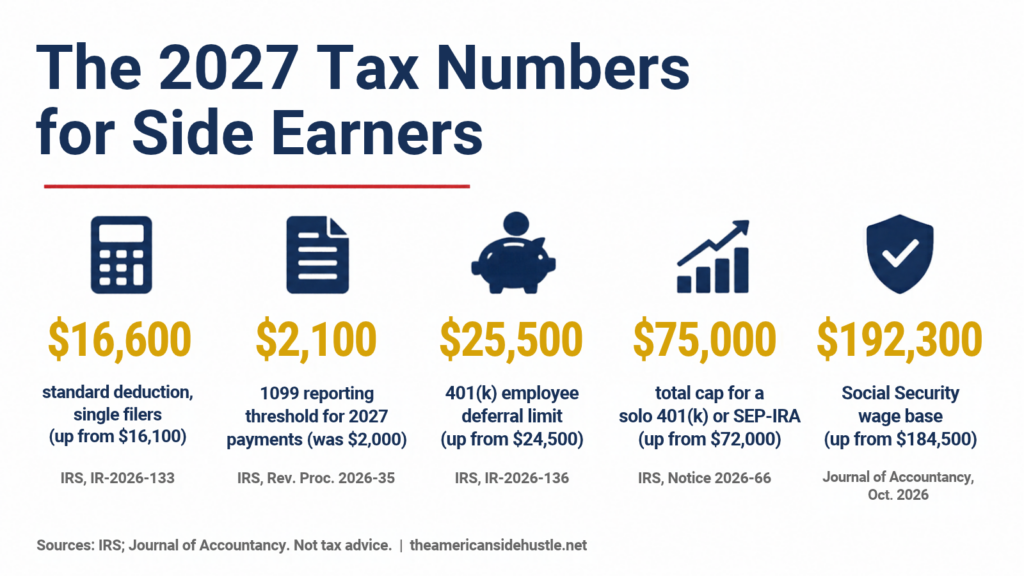
The standard deduction rises too: $16,600 for single filers, $33,200 for married couples filing jointly and $24,925 for heads of household. That’s $500 more for singles and $1,000 more for couples than 2026.
How big is the bump overall? The Tax Foundation’s Alex Durante, a senior economist there, put the average increase at “about 3.2 percent,” in the group’s 2027 bracket breakdown published Nov. 6. He also explained why the IRS bothers: “Bracket creep occurs when inflation, rather than real increases in income, pushes people into higher income tax brackets.”
The 1099 threshold ticks up to $2,100
This one matters a lot if clients pay you as a contractor. Buried in Revenue Procedure 2026-35, section 3.52, is this: “For payments made in calendar year 2027, the reporting threshold for payments described in § 6041(a) is $2,100.”
Context: for years that number was $600. The IRS’s 1099 filing page says payments made in 2026 have a $2,000 threshold. Now it’s $2,100 for 2027. In plain words, a client who pays you $1,900 next year probably won’t send you a form. You still owe tax on it.
Retirement limits went up, except one
A week later, on Nov. 12, the IRS released the 2027 retirement numbers. Per IR-2026-136, the 401(k) employee deferral limit rises to $25,500 from $24,500. The catch-up for people 50 and older goes to $8,500, so they can put in up to $34,000. People aged 60 to 63 get a higher catch-up of $11,750.
The IRA limit did not move. It stays at $7,500, after a $500 increase for 2026, as InvestmentNews noted. The Roth IRA income phase-out for single filers moves to $158,000 to $173,000.
For self-employed people, the big number is in IRS Notice 2026-66: the overall limit on defined contribution plans is “increased in 2027 from $72,000 to $75,000.” That’s the ceiling for a solo 401(k) and a SEP-IRA. The compensation limit those plans can count goes from $360,000 to $375,000.
None of this was a total surprise. In September, consulting firm Milliman projected the $25,500 deferral limit and the $75,000 cap, 401k Specialist reported, noting that “since September 30, 2025, the CPI has increased about 3.1%.” CPA Practice Advisor confirmed the final figures the day they dropped.
The Social Security wage base jumps to $192,300
Back on Oct. 14, Social Security set its 2027 numbers. The wage base, which is the amount of earnings hit by the 6.2% Social Security tax, rises to $192,300 from $184,500, the Journal of Accountancy reported. Benefits get a 3.6% cost-of-living increase.
Why do you care? Because if you’re self-employed, you pay both halves. The IRS’s self-employment tax page is blunt: “The self-employment tax rate is 15.3%,” made up of 12.4% for Social Security and 2.9% for Medicare. Inflation adjustments don’t touch that rate.
A few more 2027 numbers worth knowing
- QBI deduction: the income level where limits start kicking in for the qualified business income deduction rises to $208,300 for single filers and $416,600 for joint filers, per Rev. Proc. 2026-35.
- HSA: if you’re on a qualifying high-deductible health plan, you can put $4,500 (self-only) or $9,000 (family) in a health savings account in 2027, per Rev. Proc. 2026-24.
- Working abroad: the foreign earned income exclusion rises to $137,300 from $132,900. If you earn in USD while living abroad, that’s your new number.
| Number | 2026 | 2027 |
|---|---|---|
| Standard deduction, single | $16,100 | $16,600 |
| Standard deduction, married filing jointly | $32,200 | $33,200 |
| 22% bracket starts (single, taxable income) | Over $50,400 | Over $52,025 |
| 24% bracket starts (single, taxable income) | Over $105,700 | Over $109,125 |
| Social Security wage base | $184,500 | $192,300 |
| 1099 reporting threshold | $2,000 | $2,100 |
| 401(k) employee deferral | $24,500 | $25,500 |
| Total cap, solo 401(k) / SEP-IRA | $72,000 | $75,000 |
| IRA contribution | $7,500 | $7,500 |
| Foreign earned income exclusion | $132,900 | $137,300 |
Sources: IRS IR-2026-133, Rev. Proc. 2026-35, IR-2026-136, Notice 2026-66; Journal of Accountancy. Not tax advice.
Here’s my take on the 2027 tax numbers for side earners
Okay. Real talk.
Headlines like “IRS raises brackets” make it sound like everybody gets a tax cut. Not really. Inflation adjustments mostly keep you where you were. If your prices went up, your rent went up and your income went up the same 3%, you’re running in place. That’s the point of indexing. It stops the bleeding. It doesn’t hand you money.
Let me show you what it’s worth in real dollars. This is my rough math, not tax advice. Say you’re single and your taxable income would have crossed into 22% in 2026. In 2027, the first $1,625 above the old line is taxed at 12% instead of 22%. That’s about $162 less. Add the $500 bigger standard deduction, which at a 22% rate is worth about $110. Call it roughly $270 for a lot of middle-income earners. Nice. Not life-changing.
Now here’s what does change your life: self-employment tax. It doesn’t care about brackets. LendingTree’s 2026 survey found the average side hustler brings in $1,242 a month, per its side hustle report. That’s $14,904 a year. At 15.3%, that’s up to about $2,280 in self-employment tax, a bit less after the standard adjustments on Schedule SE, and before a dollar of income tax. A lot of people find out about that number in April.
And the higher Social Security wage base cuts the other way for top earners. If you make more than $184,500 in combined wages and self-employment earnings, the 12.4% now applies to $7,800 more of your income. By my math, that’s up to $967 more in self-employment tax for someone who’s maxed out.
The quiet winner here is retirement. A solo 401(k) cap of $75,000 is a huge amount of room for a one-person business. And almost nobody uses it. Vanguard’s How America Saves 2026 found only 14% of participants in its workplace plans hit the employee maximum in 2025. Those are people with an employer nudging them. Freelancers have nobody nudging them.
That’s why this matters for our crowd. The number of people doing this keeps growing. MBO Partners’ 2026 State of Independence study counted a record 74.9 million Americans working independently, with 5.8 million earning more than $100,000, SelfEmployed.com reported. Teresa Creech, president of MBO Partners by Beeline, said companies “can’t assume skills will always be available through traditional hiring.” More of that work is landing on independent people. More of those people need a tax plan.

What you actually need (and what it costs)
Good news: planning for 2027 costs almost nothing. Here’s the kit.
- A separate business account. Shop around for one with no monthly fee. Every client payment lands there. Every business expense leaves from there. That alone makes taxes much easier.
- A tax savings bucket. A plain high-yield savings account works. You move a set share of every payment into it the day it arrives.
- The IRS’s own tools. Free. The IRS estimated taxes page explains who has to pay quarterly and how to pay online, by phone, through the IRS app or through your IRS online account.
- A retirement account built for self-employed people. Compare providers on account fees and fund costs before you open one. The IRS explains how the one-participant 401(k) works and the rules for a SEP-IRA.
- Clean invoicing. If clients pay you through one system, your records build themselves. I like having invoices, payments and client follow-up in one place, like GoHighLevel, so a year of income is one export instead of a weekend of digging.
- A tax pro, once a year. Prices vary a lot by city and by how messy your books are. One good planning session in January usually beats a panic session in April.
How I’d play it
If I had side income and wanted 2027 to be the year taxes stop surprising me, here’s my order.
Step one: write down your 2027 income guess. Not a dream number. A realistic one. Look at what you earned in 2026, then adjust for clients you know you’ll keep or lose. If you need a reality check on where side income is heading, read what side hustles are working in late 2026. Your guess drives everything else.
Step two: rerun your tax set-aside percentage. Using the 2027 brackets and the 15.3% self-employment tax, figure out what share of each payment to save. SelfEmployed.com made the point well in its Nov. 11 write-up: freelancers don’t have employer withholding, so bracket changes flow straight into their quarterly estimates. Don’t keep last year’s percentage just because it’s a habit.
Step three: set your quarterly payments to the safe harbor. The IRS says you generally have to pay estimated tax if you expect to owe $1,000 or more. You can usually avoid the penalty by paying at least 90% of this year’s tax or 100% of last year’s, whichever is smaller. For most people with growing side income, I’d use last year’s total tax as the floor, split into four payments. Simple. Predictable. If your income is high or jumping fast, check the IRS rules for your situation before you lock this in.
Step four: track every 1099 dollar, even without a 1099. With the threshold at $2,100, plenty of smaller clients won’t send a form. Keep a simple spreadsheet: date, client, amount, how they paid. Match it to your bank deposits each month. If a client pays you $1,800 and never sends a 1099, that $1,800 is still income.
Step five: pick your retirement account in January, not April. A solo 401(k) lets you contribute as the “employee” up to $25,500 and as the “employer” on top, up to the $75,000 total. As the IRS puts it, “the business owner wears two hats.” A SEP-IRA is simpler: one contribution, up to 25% of compensation, same $75,000 cap. Open it early, then automate a monthly transfer. Even a few hundred dollars a month adds up.
Step six: use the HSA if you qualify. If your health plan is a qualifying high-deductible plan, the 2027 HSA limits are $4,500 self-only and $9,000 family. Ask your plan or a tax pro whether you qualify before you contribute.
Step seven: get paid like a business. Raise your rates on schedule, not when you’re desperate. Milliman’s report put inflation at about 3.1% over the past year. Your rates can move too. If you need help pricing bigger projects, see why freelancing in late 2026 is about bigger projects.
Watch-outs
Don’t confuse “brackets went up” with “I pay less.” If your income rises faster than about 3.2%, you can still land in a higher bracket. That’s real growth, not creep. Good problem. Plan for it.
Don’t forget self-employment tax. The 15.3% rate didn’t change, and nothing in this year’s releases lowers it. Many people budget for income tax and get blindsided by this one.
Don’t lean on unpredictable income without a cushion. LendingTree’s chief consumer finance analyst, Matt Schulz, said it plainly: “Relying on side hustles can be risky, in large part because of how unpredictable side hustle income can be.” Keep your tax bucket separate from your emergency fund.
Don’t use projections as filing numbers. Before Nov. 5, plenty of sites published estimated 2027 brackets. Use the official IRS numbers in this article, and recheck any figure on IRS.gov before you file.
Don’t miss the employer side of retirement. The self-employed math for solo 401(k) and SEP contributions is different from a regular paycheck. The IRS says you need a “special computation” using Publication 560. Get it right, or get help.
Quick answers
When do the 2027 numbers apply? To income you earn in 2027, reported on returns you file in 2028.
Did the IRA limit go up? No. It stays at $7,500, with a $1,100 catch-up for people 50 and older.
Will I get a 1099 for every client? No. For 2027 payments, the reporting threshold is $2,100. You report all income either way.
The bottom line
The 2027 numbers are out. The brackets moved up about 3.2%, the standard deduction is bigger, the 1099 line is $2,100, the solo 401(k) and SEP cap is $75,000, and the Social Security wage base is $192,300. None of that will make you rich. All of it changes how much you should set aside and where you should put it.
So take 30 minutes this week. Guess your 2027 income. Redo your set-aside percentage. Pick your retirement account. Set your four payments. Then go back to building.
New numbers. New plan. That’s the play.
And if you want the money side of your business to run itself, invoices, follow-up and text-to-pay in one dashboard, that’s what we built at The American Side Hustle. Earn in USD. Live anywhere. Keep more of what you earn.
Tools I’d use for this
- GoHighLevel: invoices, payments and client follow-up in one place, so a year of income is one clean export.
- Hostinger Business Email: a separate business inbox so every invoice, receipt and 1099 lands in one spot.
Some of these are affiliate links. If you sign up through them we may earn a commission, at no extra cost to you. See all our picks on the Recommended Tools page.
Photos: Nataliya Vaitkevich, Tima Miroshnichenko and Joslyn Pickens on Pexels. Graphics: The American Side Hustle. Figures checked on official IRS pages Nov. 25, 2026, and may change. This article is general information, not tax advice.
Ready to build your own American side hustle?
Get funnels, automated follow-up, text-to-pay and courses in one dashboard. Earn in USD, live anywhere.