It’s the Tuesday before Thanksgiving. Somebody just finished a full shift, and now they’re sitting in the car, phone propped on the dash, waiting for a delivery order to ping.
Twenty minutes. Nothing. Then a $6 offer for a nine-mile drive.
Across town, somebody else is assembling a bookshelf for a stranger at close to forty bucks an hour.
Same holiday season. Same “side hustle” label. Totally different math.
This one’s for you if you’re trying to squeeze extra money out of the next six weeks, or want something steadier going into 2027, and you’re tired of side hustle lists that promise everything. I pulled the latest surveys, the government job numbers, the platform pay data and the IRS fine print. Here’s what’s working, what it costs, and where the hype falls apart.


Short version, so you remember it: Sell a skill. Track every dollar.

Here’s what’s going on
The headline that surprised me: fewer Americans are side hustling than a few years ago. But the people who stuck with it are earning more. That’s not a contradiction. It’s a sorting.
Fewer hustlers, bigger checks
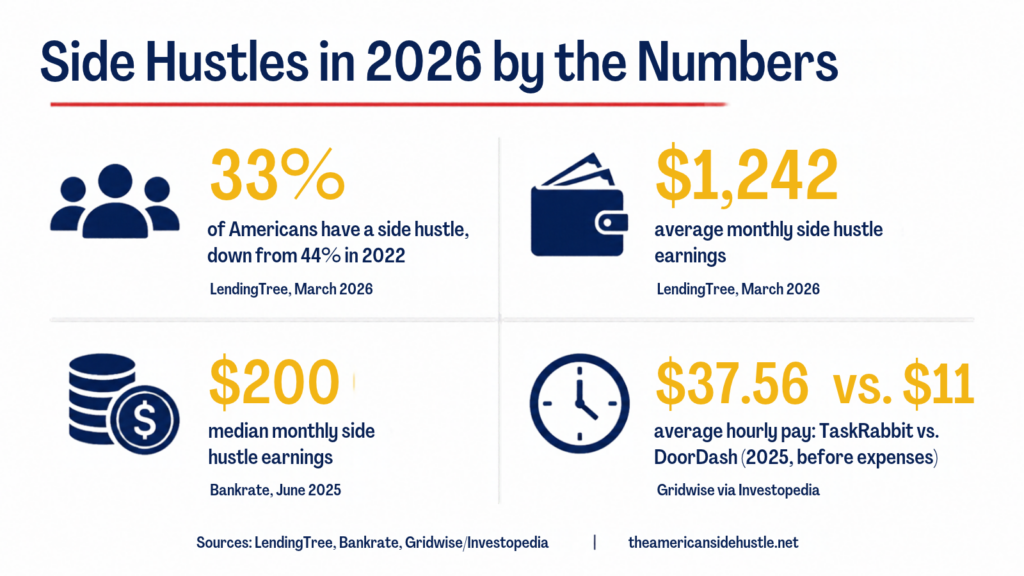
In LendingTree’s 2026 survey of 2,049 adults, taken in early March, 33% of Americans said they have a side hustle, down from 38% last year and 44% in 2022, according to LendingTree. The drop was steepest among Gen Z, falling to 43% from 57% a year earlier.
But look at the money. Side hustlers in that survey reported an average of $1,242 a month, up from $1,215 last year and way up from $473 in 2022. And 61% said their life would be unaffordable without that income.
Bankrate saw the same participation drop in its most recent survey, from June 2025: just 27% of adults had a side hustle, down from 36% the year before, Bankrate reported. Here’s the number I want you to remember from that one, though. The average was $885 a month. The median was $200. Only 14% of side hustlers made more than $1,000 a month.
Translation: a small group earns a lot, and they drag the average up. Most people make pocket money. Both things are true at the same time.
| Survey | When | Share with a side hustle | Monthly earnings |
|---|---|---|---|
| LendingTree | March 2026 | 33% (was 44% in 2022) | $1,242 average |
| Bankrate | June 2025 | 27% (was 39% in 2023) | $885 average, $200 median |
| Federal Reserve (SHED) | October 2024 | 20% did gig work in the prior month | 70% worked under 5 hours a week |
| BLS (official jobs data) | October 2026 | 5.4% of workers hold more than one job | — |
Sources: LendingTree (updated Apr. 20, 2026), Bankrate (July 9, 2025), Federal Reserve Economic Well-Being report (2024 data), BLS Employment Situation (Nov. 6, 2026). Each survey defines “side hustle” differently, so compare the trends, not the exact percentages.
What the government numbers say
Surveys are one thing. The Bureau of Labor Statistics counts people who formally hold more than one job. In its October report, released November 6, the BLS counted 8.8 million multiple jobholders, or 5.4% of everyone employed, seasonally adjusted, down from 8.99 million in September, per the BLS Employment Situation release. The same report showed people working part time for economic reasons jumped by 339,000 to 4.8 million. That’s people who want more hours and can’t get them.
Economists at the Richmond Fed dug into 30 years of this data on an October 14 episode of their “Speaking of the Economy” podcast. Regional economist Kyle DeMaria said the rate has been “remarkably stable — between 5 and 6 percent — for the last 20 years.” Two details jumped out at me. The second job makes up about a quarter of these workers’ total earnings. And college grads went from about a third of multiple jobholders in the 1990s to about half in 2024.
Senior policy economist Urvi Neelakantan added the twist: “We found, to my surprise, that the multiple-jobholding rate is actually higher when the economy is doing well.” In other words, side income isn’t only a panic move. Plenty of people stack income because opportunity is there.
The holiday crunch is real
Now the seasonal part. A resume.io survey of 1,000 full-time workers, reported November 12 by CPA Practice Advisor, found 53.6% have taken on or plan to take on extra work to cover holiday costs. That breaks down to 29.4% picking up extra shifts, 24.6% doing freelance work or a side hustle and 19.3% taking a seasonal job. Among Gen Z, it’s 72.5%. And 27.1% are borrowing to get through the holidays.
The demand side is there to meet them. The National Retail Federation forecasts November and December sales to grow 4.2% to $1.013 trillion, with retailers hiring 325,000 to 375,000 seasonal workers. “We head into the holiday season with strong spending momentum, as consumers remain the bright spot in the economy,” said NRF chief economist Mark Mathews. Online, Adobe expects a record $275.1 billion in U.S. holiday spending, with Cyber Monday (November 30 this year) forecast at $15.1 billion.
Amazon alone said on October 20 that it’s hiring more than 300,000 people for the season, with seasonal workers averaging $20 an hour. Starting January 1, 2027, seasonal employees working at least 30 hours a week become eligible for healthcare coverage. That’s worth weighing if you’re comparing a seasonal job to app work.
The platform pay gap is huge
This is the part that should change how you pick. Gridwise, which tracks gig workers’ earnings, analyzed nearly $11 billion in pay across more than a billion tasks in 2025. Investopedia reported the results (republished on AOL): TaskRabbit workers averaged $37.56 an hour. Walmart’s Spark Driver was $26. Uber was $24.88. Amazon Flex was $22.60. DoorDash was about $11 an hour.
Same report: customer prices rose 9.6% and platform fees per trip rose 33%, while driver pay per hour rose just 4.1%. And remember, those hourly numbers are before gas, insurance and wear on your car. Some companies push back. Uber says its median U.S. driver earns more than $30 per “utilized hour,” and Instacart disputed Gridwise’s method entirely. So treat any single number as a range, not a promise.
Delivery tells the same story. Food On Demand reported that delivery pay rose 3.2% to $14.66 an hour from late 2024 to late 2025, while hours worked rose 5.2%. Tips are about half of delivery pay, and Gridwise’s report page shows delivery tips per trip sliding to $4.16, near the lowest on record.
Selling stuff is quietly winning
Don’t sleep on resale. ThredUp’s 14th annual Resale Report, released April 2, says U.S. secondhand apparel grew nearly four times faster than the broader clothing market in 2025, and projects the U.S. market will hit $78.8 billion by 2030, according to ThredUp. Nearly half of shoppers now find secondhand items through social media and creators. “Resale is no longer just growing, it’s taking direct market share,” said CEO James Reinhart.
That matches the Fed’s data: in its latest gig survey, 10% of adults had sold things they already owned in the prior month, the single biggest gig activity, per the Federal Reserve’s household report.
Here’s my take
Okay. Let me say the quiet part out loud.
The average side hustle check is real. The typical one is small.
When you see “$1,242 a month,” that’s an average. Bankrate’s median of $200 is the more honest picture of what a regular person makes in a regular month. Not nothing. Not quitting-your-job money either.
Here’s what I see in the data, and why I’m still bullish.
- Skills beat shifts. The highest-paying app on that Gridwise list wasn’t driving. It was TaskRabbit, where people get paid to do things: assemble, mount, fix, move. The lowest was food delivery. The more your work depends on a skill, the more pricing power you have. That’s the pattern every time.
- The platform sets your ceiling. When fees per trip go up 33% and your pay goes up 4%, you’re not the one winning. App work is a great on-ramp for cash this week. It is not a business. You don’t own the customer.
- Own the customer and the math flips. A dog walker on an app gets one booking. A dog walker with their own text list gets every repeat booking, every referral, every holiday rush. That’s the whole American Side Hustle idea: build something where the customer relationship belongs to you.
Matt Schulz, LendingTree’s chief consumer finance analyst, put it plainly: “Relying on side hustles can be risky, in large part because of how unpredictable side hustle income can be.” He’s right. And he added, “Millions of Americans do it every month, but that doesn’t make it a walk in the park.” Amen.
My honest ranking? Seasonal work if you need guaranteed cash fast. Skilled task work if you have tools and two free evenings. Reselling if you’ve got a full closet and a phone camera. Freelance services if you have a skill businesses pay for, because that one can become something you own.

What you actually need (and what it costs)
Good news: most of these cost very little to start. The hidden costs are taxes and your car.
- Seasonal job: $0 to start. Amazon says new roles are posted weekly October through December, at an average of $20 an hour for seasonal work. Taxes come out of your check like any job.
- Task work (TaskRabbit): a one-time, non-refundable $25 registration fee in applicable cities. TaskRabbit’s own help page says paying it “doesn’t guarantee you’ll become a Tasker,” and that “all fees are charged to Clients, not Taskers.” Add whatever tools you already own.
- Driving and delivery: no sign-up fee for most apps, but your car is the real cost. The IRS business mileage rate is 76 cents a mile for July 1 through December 31, 2026 (72.5 cents for the first half). That’s a deduction, yes, but it’s also the IRS telling you roughly what driving costs. Ten miles for a $6 order? Do the math before you accept.
- Reselling: almost free if you start with what you own. Marketplace fees vary, so check each platform’s fee page before you list.
- Freelance services: a laptop, a simple portfolio page and a way to get paid.
Then the tax part nobody puts in the YouTube thumbnail. If your net self-employment earnings hit $400 or more, you owe self-employment tax of 15.3% (12.4% Social Security plus 2.9% Medicare), on top of regular income tax. And payment apps only send a Form 1099-K when you pass $20,000 in more than 200 transactions, but the IRS is clear on its Form 1099-K page: “Whether or not you receive a Form 1099-K, you must still report any income on your tax return.” No form doesn’t mean no tax. I’m not a tax pro, so talk to one if your numbers get real.
How I’d play it
If I were starting from zero today, with the holidays coming and 2027 right behind them, here’s the order I’d do it in.
Step one: decide what the money is for, and how much. The resume.io survey found the top reasons for holiday extra work were food and household bills (23.3%), gifts (21.1%) and existing debts (18.9%). Write your number down. “$600 by December 20 for gifts” is a plan. “Make extra money” is a wish. Your number decides whether you need fast cash or a long game.
Step two: if you need cash in two weeks, take the boring option. A seasonal job pays on a schedule and withholds taxes for you. It’s not glamorous. It’s predictable. Predictable is underrated in December.
Step three: if you drive, track your real hourly rate for one week. Write down every hour you’re logged in, every mile, every dollar after tips. Then subtract mileage at the IRS rate. Gridwise’s numbers are averages across millions of tasks. Yours could be better or worse, and the only way to know is one honest week of tracking. If your net is under what a seasonal job pays, switch.
Step four: sell what’s already in your house before you buy anything to resell. Holiday shoppers are online in record numbers, and secondhand is outgrowing regular retail. Start with stuff you own, so your cost is zero. Learn what sells and what sits. Then think about sourcing inventory.
Step five: turn one skill into a named offer. Furniture assembly. Holiday light hanging. Gift wrapping for small shops. Year-end bookkeeping cleanup. Social posts for a local restaurant’s January promo. Pick one, give it a price and a name, and tell 20 people you know. Skill-based work is where the higher hourly rates live, and your network is free marketing.
Step six: capture every customer. The step everybody skips. Get the name, the number and permission to follow up. A one-time holiday job becomes a spring job, a referral, a regular.
Step seven: set aside taxes from the first dollar. Open a separate account and move a chunk of every payment into it. With 15.3% self-employment tax plus income tax, you don’t want April to eat your December. Keep receipts and a mileage log from day one.

Watch-outs
Side hustle scams spike when people are stretched. Americans reported losing $15.9 billion to fraud in 2025, up from more than $12 billion the year before, the FTC said in March. One in three people who lost money to a job or business opportunity scam in 2025 said it started on social media, per an FTC Data Spotlight. The FTC’s rule of thumb from its job scam alert is simple: “Never pay anyone to get a job.” A legit platform registration fee posted on its official site is one thing. A stranger in your DMs asking for money to “unlock tasks” is a scam.
Gross isn’t net. The hourly figures here are before gas, insurance, supplies, fees and taxes. Know your net.
Don’t borrow to start a hustle that’s supposed to pay off borrowing. More than a quarter of workers in the resume.io survey are borrowing for the holidays. If your plan needs a credit card to launch, shrink the plan.
Burnout is a cost too. The same survey found financial stress was the top driver of work exhaustion. “The goal is to improve your financial situation without sacrificing your well-being in the process,” said resume.io career expert Amanda Augustine. Pick a stopping point before you start.
Quick answers
What’s the best long-term side hustle? Based on the pay data, skill-based work where you own the customer relationship. That’s the one that can grow into something.
How much will I realistically make? Bankrate’s median was $200 a month. LendingTree’s average was $1,242. Plan for the first, work toward the second.
The bottom line
Side hustling isn’t dead. It’s getting sorted. Fewer people are doing it, the ones who stick with it earn more, and the gap between low-pay app work and skilled work is wider than most people realize.
Use the holidays for quick cash if you need it. But use the next six weeks to build one offer, one customer list and one honest spreadsheet. That’s what carries you into 2027.
Sell a skill. Track every dollar. That’s the play.
And when you’re ready to turn that skill into something you own, with a simple funnel, automatic follow-up and text-to-pay so customers come back without you chasing them, that’s exactly what we built at The American Side Hustle. Earn in USD. Live anywhere.
Tools I’d use for this
- GoHighLevel: the all-in-one CRM I build on: funnels, missed-call text back, email and booking.
- Skool: the simplest way to run a paid community and course in one place.
Some of these are affiliate links. If you sign up through them we may earn a commission, at no extra cost to you. See all our picks on the Recommended Tools page.
Photos: Athena Sandrini, Tima Miroshnichenko and RDNE Stock project on Pexels. Graphics: The American Side Hustle. Prices checked on official pages Nov. 24, 2026, and may change.
Ready to build your own American side hustle?
Get funnels, automated follow-up, text-to-pay and courses in one dashboard. Earn in USD, live anywhere.