You flip the switch. Your Skool group goes from free to $29 a month.
Twelve people pay in the first week. You’re thrilled.
Then month three hits. Four of them cancel. Two cards fail. And you’re staring at the dashboard wondering if you priced it wrong, or built it wrong.
That’s the moment most people get the diagnosis backwards. If you want to launch a paid Skool community that lasts, the price is only half the job. The other half is giving people a reason to still be there in month four.
Some links in this article are affiliate links. If you buy through them, we may earn a commission at no extra cost to you.


This one’s for you if you’ve got a free group, an email list or a following, and you’re ready to charge. Maybe you already run a coaching offer and want a cheaper door into it. I went through Skool’s own help center pages on pricing models, tiers, free trials, proration, analytics and plugins. I also pulled new pricing data on 48,000 Skool groups and the latest churn research.
Keep this line in your pocket: Price for the promise. Build for month four.

Here’s what’s going on when you launch a paid Skool community
Quick map first. If you want the basics on Skool’s plans, Discovery and Growth Boost, I covered those in what a Skool paid community costs in 2026. If you’re still deciding on a platform, read Skool alternatives with fees side by side. This piece is about the next step: pricing, launching and keeping the people who pay.
Skool now gives you five ways to charge
Per Skool’s pricing setup guide (last updated Oct. 28, 2025), a group can be Free, Subscription (monthly or annual, with an optional 7-day free trial), Freemium, Tiers, or One-time. Freemium and Tiers are marked “NEW.” The difference is simple: Freemium is one free plan plus one paid plan, while “Tiers has all paid plans, whilst freemium has one free plan.” Skool suggests one-time pricing for lifetime access, pop-up groups and seminars.
Tiers have fixed names. Skool’s proration article (updated Feb. 27, 2026) refers to them as Standard, Premium and VIP.
The classroom can do the gating for you
This is the part a lot of new owners miss. You don’t need five separate groups to sell five things. Skool’s course permissions page lists Open, Level unlock, Buy now (a one-time price for one course), Time unlock (after a set number of days from joining) and Private. Set a course to Private and a “Tier access” setting shows up, which you can combine with level, purchase or time rules.
Levels come from likes. Per Skool’s levels guide, a member earns one point each time someone likes their post or comment. Level 2 takes 5 points, Level 3 takes 20, Level 4 takes 65. So a course locked at Level 3 is really a reward for people who show up and help.
Raising prices later is safer than you think
Skool’s Payments FAQ (updated Nov. 4, 2026) says that when you change your price, “Existing members will be grandfathered on the price they’re currently paying; this could be free.” Their example: a member paying $99 stays at $99 when the group goes to $150. New people pay the new price. All subscription prices are set in U.S. dollars, and payouts land every Wednesday.
That one rule is why a “founding member” price works on Skool. Launch low, reward the first believers, raise it later.
Upgrades and downgrades have a catch
Upgrades charge right away, adjusted for time already paid. Skool’s example: moving from $9 to $99 a month, 15 days in, costs $94.82. Switching between monthly and annual charges the full new price immediately with no credit, and dropping from VIP to Premium “revokes the higher plan’s benefits immediately,” per the same page.
What Skool groups actually charge
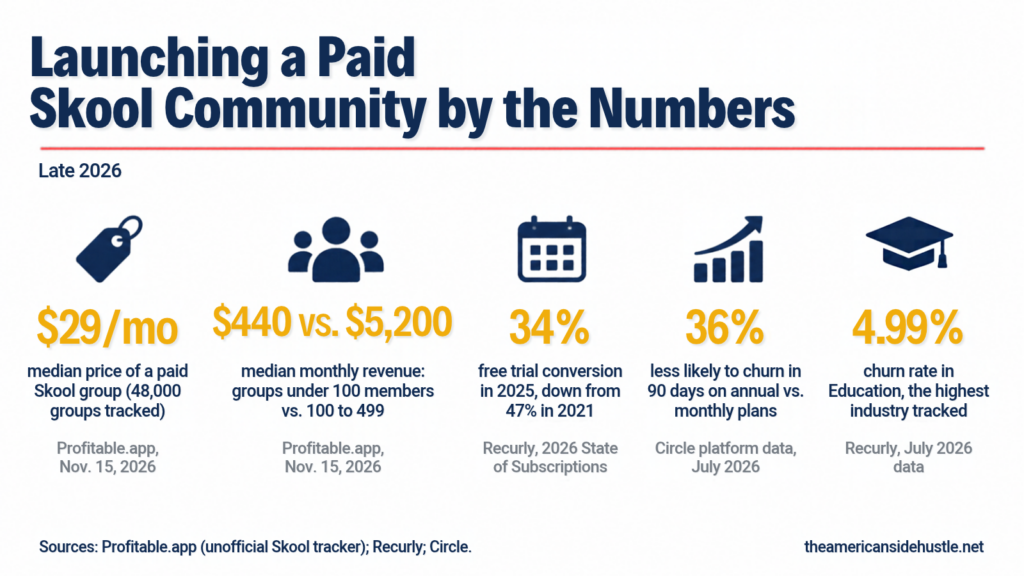
Skool doesn’t publish creator revenue. A third-party tracker does its best. Profitable.app (updated Nov. 15, 2026) tracks 48,000 Skool groups, says 33.8% are paid, and puts the median paid price at $29 a month. The most common price band is $26 to $50.
| Monthly price | Paid Skool groups |
|---|---|
| $1 to $10 | 3,500 |
| $11 to $25 | 2,900 |
| $26 to $50 | 4,700 |
| $51 to $100 | 2,600 |
| $101 to $200 | 702 |
| $201 to $500 | 455 |
| $500+ | 438 |
Now look at what size does to revenue, from the same tracker:
| Members in a paid group | Median estimated MRR |
|---|---|
| Under 100 | $440 |
| 100 to 499 | $5,200 |
| 500 to 999 | $14,500 |
| 1,000 to 5,000 | $23,000 |
| 5,000+ | $65,300 |
Source: Profitable.app, Nov. 15, 2026. MRR is estimated as price times current members, so treat it as a ceiling, not real revenue. Not affiliated with Skool.
Read that second table twice. The median paid group under 100 members makes an estimated $440 a month. Get to 100 to 499 members and it jumps to $5,200. Size matters more than price. These are upper-bound estimates, and the page disagrees with itself in spots (its text says a $33 median price, its stat card $29), so I treat it as directional.
Free trials convert worse than they used to
Recurly, whose report draws on data from more than 2,200 subscription businesses, says traditional free-trial conversion fell from 47% in 2021 to 34% in 2025, per its 2026 State of Subscriptions summary. Same report: 51% of consumers who canceled said they weren’t using the service enough, and 38% would rather pause than cancel. Nearly one in four new subscriptions comes from a former customer, and annual plans bring in 50% to 60% more revenue per user than monthly, according to Advanced Television’s coverage.
Brian Geier, Recurly’s VP of business intelligence, put it well: “When brands support flexibility, customers come back when the value is there,” he told Advanced Television. CEO Joe Rohrlich added that consumers “have not lost interest in subscriptions.” They are “simply making clearer choices.”
Churn hits early, and education churns the most
On Recurly’s churn benchmark page (July 2026 network data), Education has the highest churn of any industry it tracks: 4.99% total, 3.30% voluntary and 1.69% involuntary (that’s failed payments). The $10 to $25 price band carries the highest churn of any price tier at 4.29%. That’s exactly where a lot of Skool groups sit.
Circle, a Skool competitor, says its own platform data shows cancellations cluster early and “most members who leave do so before month four.” It also found that “annual subscribers are 36% less likely to churn in their first 90 days than monthly subscribers,” per Circle’s July 2026 guide. That’s a vendor’s own data with no sample size given, so weigh it accordingly. But it lines up with everything else.
Here’s my take on pricing a paid Skool community
Okay. Real talk.
Most people obsess over the number. $19 or $29? But size drives revenue more than price, and churn decides your size. So the real question is: what makes someone still glad they’re paying in month four?
Richard Millington, the community strategist behind FeverBee, nailed the trap years ago. He wrote that “Paid membership sites often follow a similar arc,” where easy early sign-ups give way to a stall, and “When people’s credit cards expire, so does their membership,” per his FeverBee essay. His fix isn’t more videos. It’s connection: “The best paid membership sites create an environment that connects people.” I agree with him. If your group is a course with a comment box, it’s a magazine subscription. People cancel magazines.
Here’s what I like about Skool for this: the churn-fighting tools are built in. Grandfathered pricing rewards first members. Level locks reward participation. Time unlock drips content. A cancellation video catches people on the way out. None of it costs extra on Pro.
Now, what I’m skeptical about. Free trials. Recurly’s number says roughly a third of trials convert. On Skool, a 7-day trial on a $29 group means a stranger can binge your best content for a week and leave. If your value is in the classroom, a trial gives it away. If your value is in the people and the weekly calls, a trial can work, because a week shows them the vibe. Know which one you are.
And I’ll be honest: a paid Skool group isn’t passive. It’s a weekly show you host. That’s also why it pays.

What you actually need (and what it costs)
Prices from official pages, checked today:
- Skool: Per Skool’s pricing page, Hobby is $9 a month with a 10% transaction fee, and Pro is $99 a month with a 2.9% fee. Both include unlimited members, courses and live calls, plus a custom URL and affiliates. The yearly toggle shows “2 months free!” Skool’s payment terms mention a 14-day free trial for owners and say there are no refunds for partial billing periods. You can start a Skool group here.
- Pro-only retention tools: Skool’s plugins page (updated Aug. 29, 2026) lists AutoDM, Onboarding Video, Cancelation Video, Zapier and Webhook as Pro features. Membership Questions and the spam-control unlocks work on both plans.
- An email tool: Kit is free up to 10,000 subscribers, per Kit’s pricing page. Creator is $39 a month, with a $20-a-month deal for the first three months that ends Dec. 1.
Here’s the fee math I’d run before picking a plan. I used Skool’s listed fees (Hobby 10% plus 30 cents, Pro 2.9% plus 30 cents per transaction, as defined in its analytics definitions), all monthly members, no affiliates, no Growth Boost.
| Members at $29/mo | Gross | You keep on Hobby | You keep on Pro |
|---|---|---|---|
| 20 | $580 | $507 | $458.18 |
| 50 | $1,450 | $1,281 | $1,293.95 |
| 100 | $2,900 | $2,571 | $2,686.90 |
| 300 | $8,700 | $7,731 | $8,258.70 |
My math from fees on Skool’s pricing page and Payments FAQ, after the plan fee, before taxes. Your numbers will differ.
The crossover lands at about $1,268 a month in gross sales. Below that, Hobby keeps more in your pocket. Above it, Pro wins, and you get the retention plugins. If you plan to grow past about 44 members at $29, I’d start on Pro.
How I’d play it
If I were turning a free audience into a paid Skool group today, here’s my order.
Step one: write the promise before the price. One sentence: who it’s for, what they get, and by when. “Weekly hot seats for new bookkeepers landing their first five clients.” If you can’t say it in one line, people can’t buy it. Price against the outcome. The $26 to $50 band is the most common on Skool, so $29 or $49 won’t shock anyone.
Step two: launch a founding-member price to your list first. Email your list and offer a lower founding price for a short window. Because Skool grandfathers existing members on their current price, those founders keep it when you raise it later. Want a cohort feel? Skool’s Lockdown setting “stops new members from joining or requesting access” while current members keep access and billing. Close the doors after launch week, then reopen at the new price. If you’re starting from zero, here’s how I’d grow an email list from X first.
Step three: pick one model and skip the trial at first. I’d start with plain Subscription, monthly plus annual. Offer annual right away; Circle’s data and Recurly’s both point to annual members staying longer and paying more. Hold off on Freemium and Tiers until you have 50 paying members and know what they actually value. Then add a VIP tier for the people asking for more of you.
Step four: build the first seven days on purpose. Turn on AutoDM. Skool’s AutoDM guide says it sends 1 to 5 minutes after someone joins and supports #NAME# and #GROUPNAME#. Ask one question: “What do you want from this group in 30 days?” Add a short onboarding video and a “Start here” post with one small win.
Step five: put a weekly live call on the calendar. Skool’s events page lets you set recurring events daily, weekly, monthly or annually. Its Skool Call guide says you have 14 days to download a recording before it expires, so save every one to the classroom. Circle found communities that run events regularly have 4 times the monthly active users of similar groups that don’t. A weekly call is the “month four” reason.
Step six: use levels and time unlocks to reward staying. Lock a bonus course at Level 3, so it goes to people who post and help. Time-unlock module two at day 30 and module three at day 60. Now there’s always a reason to stick around past that dangerous first 90 days. Add a cancellation video that reminds people what they’d lose, which Skool says is meant “to decrease churn.”
Step seven: read your numbers every month. Skool’s analytics shows MRR, retention, About page conversion, churned members and engagement cohorts. Retention there means the share of last month’s starting MRR still active at month’s end. If you test a free trial later, Skool only counts trials that ran the full 7 days. If you want help packaging a paid course to sit next to the group, here’s a small studio’s digital product playbook.
Watch-outs
Don’t promise income. If your group teaches people to make money, be careful with screenshots and “I made $10K” posts. In January 2025 the FTC proposed expanding its Business Opportunity Rule to cover business coaching, which would require “written substantiation to back up any earnings claims.” Sell the work, not a number.
Watch the downgrade trap. A VIP member who drops to Premium mid-cycle loses VIP benefits right away. Put that in your pinned FAQ so nobody feels cheated.
Know who’s paying the Growth Boost. When Skool brings you a member through its ads, it takes a cut. Its traffic sources page gives the example of Skool deducting $3 plus fees on a $10 price, and says Growth Boost “is not recommended for high ticket sales.” Members you bring yourself pay processing fees only.
Failed cards are real churn. Recurly puts involuntary churn at 1.69% in education. Remind members to update their cards. And Skool says transaction fees are non-refundable, so refunds cost you a little.
Don’t trust one tracker. Profitable.app is unofficial. Circle and Recurly sell software. Use their numbers as a compass, not a promise.
Quick answers
Should I start free and switch to paid? You can, but Skool grandfathers existing free members at free, so they never pay. I’d launch paid to my list and keep a separate freebie as the top of the funnel.
Monthly or annual? Both. Offer annual from day one. Recurly says annual plans bring in 50% to 60% more revenue per user.
The bottom line
Skool gives you five pricing models, tiers, one-time course sales, grandfathered prices and built-in retention tools. The data says money follows size, and size follows retention. Trials convert worse than they used to, and most cancellations come before month four.
So write the promise. Launch a founding price to your list. Offer annual. Build the first week on purpose, run a weekly call, and raise the price when the group earns it.
Price for the promise. Build for month four. That’s the play.
And when your Skool group needs a funnel, follow-up texts and email, and a way to book calls with your VIP members, that’s exactly what we put together at The American Side Hustle. If you want the automation side explained first, here’s what GoHighLevel is and how I’d sell automation with it. Earn in USD. Live anywhere.
Tools I’d use for this
- Skool: tiers, one-time course sales, grandfathered pricing and retention plugins in one simple group.
- Kit: a free email plan up to 10,000 subscribers to run your founding-member launch.
- GoHighLevel: funnels, text follow-up and booking for VIP calls once the group grows.
Some of these are affiliate links. If you sign up through them we may earn a commission, at no extra cost to you. See all our picks on the Recommended Tools page.
Photos: Anna Shvets, Antoni Shkraba and kaboompics on Pexels. Graphics: The American Side Hustle. Prices checked on official pages Nov. 25, 2026, and may change.
Ready to build your own American side hustle?
Get funnels, automated follow-up, text-to-pay and courses in one dashboard. Earn in USD, live anywhere.