
Two job posts land on the same day.
One says: “Write four blog posts. $200.” The other says: “Build a chatbot for our website, write its answers, connect it to our booking calendar. $1,500.”
Same client. Same week. One of those posts is shrinking across the freelance market. The other is growing. And a new study just put numbers on the gap.
Here’s the short version: AI freelance projects are getting bigger, not cheaper. But they’re bigger in a specific way, and if you don’t understand it, you’ll keep pitching the $200 job.
Some links in this article are affiliate links. If you buy through them, we may earn a commission at no extra cost to you.


This one’s for you if you freelance, or want to, and you’ve watched AI eat the easy gigs while wondering where the good work went. I went through the new OpenAI and Upwork research, the full 24-page report behind it, Upwork’s latest quarterly numbers, the critics’ takes and the older studies that found freelancers losing work. Here’s what’s real and how I’d play it.
The line for this one: Sell the bundle, not the hour.

Here’s what’s going on with AI freelance projects
Quick context. I covered the bigger picture in freelancing in late 2026: bigger projects, not higher hourly rates, and Upwork’s on-demand hiring push in Upwork Now puts freelancers on call. This new research explains why projects are getting bigger.
The study: AI is “rebundling” freelance work
On Nov. 10, OpenAI and Upwork published joint research called “The Rebundling of Freelance Work in the AI Age.” Six researchers from both companies compared what people do in ChatGPT with what clients hire for on Upwork, across 63 types of work, according to OpenAI’s summary.
Their headline: “The findings do not point to a simple substitution story.” In 43 of those 63 categories, work that people already do a lot in ChatGPT lost share of Upwork postings, while work that’s less common in ChatGPT gained share. The other 20 went the opposite way. So, in their words, “ChatGPT use alone does not explain changes in freelance demand.”
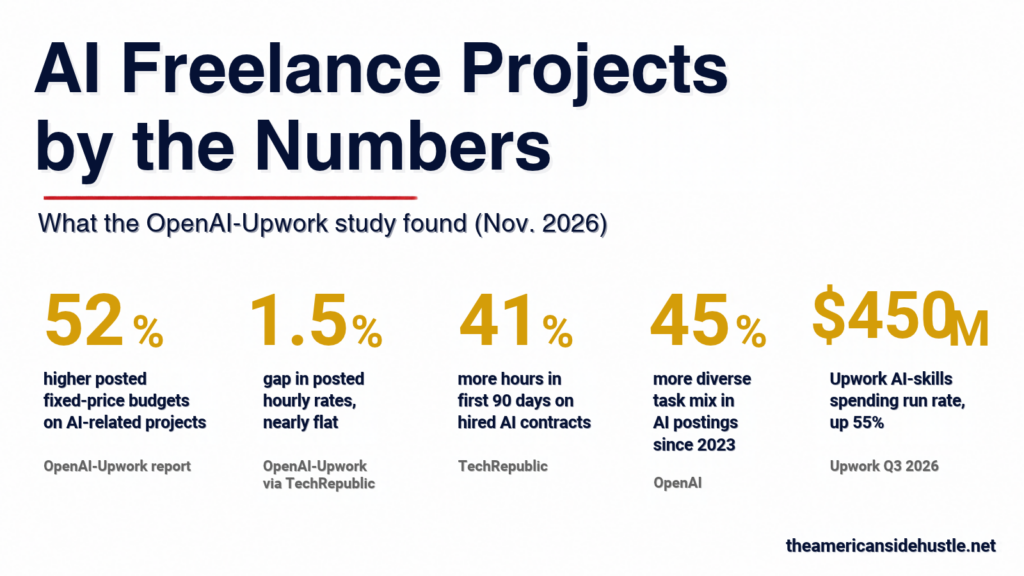
The bigger idea is in the title. Clients aren’t just hiring “a writer” or “a designer” for AI work anymore. They’re combining tasks that rarely went together before. The task mix inside AI-related postings got 45% more diverse between early 2023 and late 2025, OpenAI says. Think chatbot development plus content plus integration. Or AI video plus editing plus motion graphics.
Bigger budgets, flat hourly rates
Here’s the number everyone is quoting. In the full report, “posted fixed-price budgets are approximately 52 percent higher in AI-related postings than for non-AI work after accounting for work subcategory and posting month.” Before that adjustment, the gap was about 70%.
Now the part fewer people are quoting. The hourly rates clients posted for AI work were basically the same, just 1.5% higher after the same adjustment, TechRepublic reported. Hired hourly AI contracts logged 41% more hours in their first 90 days. AI postings asked for 3.35 distinct tasks on average, versus 3.19 for other jobs. And 8.4% of the task pairings in AI posts were unusual combinations, versus 2.4% elsewhere.
Put that together and the story is clear. Clients aren’t paying more per hour for “AI.” They’re buying more stuff in one project. The report says it directly: larger budgets “may therefore reflect larger or more intensive projects rather than simply a higher price for an otherwise identical unit of labor.”
| Measure (AI-related vs. other Upwork postings) | Gap | What it actually measures |
|---|---|---|
| Posted fixed-price budgets, adjusted | About 52% higher | What clients posted, not what freelancers were paid |
| Posted fixed-price budgets, unadjusted | About 70% higher | Raw gap before matching job type and month |
| Posted hourly rates, adjusted | 1.5% higher | Midpoint of the posted rate range |
| Hours in first 90 days | 41% more | Only hired hourly contracts with recorded hours |
| Distinct tasks per posting | 3.35 vs. 3.19 | How many kinds of work one job asks for |
| Unusual task pairings | 8.4% vs. 2.4% | Combinations rarely seen before generative AI |
Sources: OpenAI and Upwork report (Nov. 2026); TechRepublic (Nov. 18, 2026). Upwork data through April 2026; one marketplace only.
Where the demand is moving
The report names winners and losers. Content writing was “particularly prominent” in ChatGPT use, and freelance postings for it “fell at more than twice the rate of Upwork postings overall.” Meanwhile, video and animation postings “grew by about a third relative to the overall marketplace.” Clients are asking for AI in chatbot development, video production, marketing automation and app integration.
The authors’ read: ChatGPT skews toward “writing and advice,” while Upwork postings lean toward “technical implementation and visual production.” In plain words, clients do the first draft themselves now. They hire you to build, connect, produce and deliver.
Upwork’s own numbers say the same thing
Upwork’s third-quarter results, filed Nov. 2, show a marketplace that’s smaller but spending more per client. Revenue was $185.6 million and gross services volume $914.1 million, per its earnings release. That’s down 8.0% and 10.1% from a year earlier, Staffing Industry Analysts reported. But spending per active client rose 8% to $5,418, and spending on freelancers with AI skills hit an estimated annual run rate of nearly $450 million, up 55%.
Upwork’s July workforce survey of 2,400 U.S. workers found that 38% of skilled knowledge workers now freelance, up from 28%, and that freelancers doing AI work earned 34% more on average, Staffing Industry Analysts reported. But here’s the warning inside it: generative AI and creative contract starts jumped 90%, while earnings per contract fell 13%. For more complex work, per-contract earnings rose 45%, Allwork.Space noted.
Jennifer Brett, managing director of the Upwork Research Institute, put it this way: “the advantage for talent will come from becoming an AI Orchestrator,” someone who can direct and be accountable for AI across a whole workflow.
Here’s my take on AI freelance projects
Okay. Real talk.
Please don’t read “52% bigger budgets” and raise your hourly rate by half. That’s not what the data says. The hourly number barely moved. What moved is the size of the box clients want filled.
So the opportunity isn’t “charge more for AI.” It’s “deliver more of the finished thing.” The client used to hire a writer, then a designer, then a developer, then someone to hook it all up. Now they want one person, or one small team, who walks in and says, “I’ll handle all of it, here’s the price.”
That’s good news for a lot of you. If you write, you probably already know a tool or two. If you edit video, you probably already script. The money is in the combination.
But I’m not going to pretend this is all upside. The skeptics have real points. Gene Dai’s breakdown of the report notes it “describes three different things,” posted budgets, posted rates and hours, and none of them is what a freelancer actually takes home. TechRepublic adds that the 52% “shouldn’t be interpreted as a standard AI surcharge.” And this is one marketplace, studied partly by the company that runs it.
The older research is sobering, too. Xiang Hui and Oren Reshef, writing for Brookings, found that freelancers in the most AI-exposed jobs saw about 2% fewer new contracts and roughly 5% lower monthly earnings after the 2022 AI releases, with top-rated workers hit hardest. That work was published in Organization Science in November 2024. For image work, it was worse: 3.7% fewer jobs and 9.4% lower earnings, per WashU’s Olin Business School. Reshef also said something I keep coming back to: “People could get a new job working with AI to do something we haven’t even thought of yet.”
And the exposure is wide. An earlier paper by Tyna Eloundou, Sam Manning, Pamela Mishkin and Daniel Rock, “GPTs are GPTs,” estimated that “around 80% of the U.S. workforce could have at least 10% of their work tasks affected” by these models.
That’s the job. Go be the person doing the thing nobody had a name for two years ago.
What you actually need (and what it costs)
You don’t need a big stack. You need one or two tools that let you deliver a finished bundle. Prices from official pages, checked today:
- A video and audio editor, since video is one of the growing lanes. Descript has a free plan; Hobbyist is $16 a month billed yearly or $24 monthly, and Creator is $24 or $35, per Descript’s pricing page. CapCut is another option for short-form edits.
- An AI voice tool, if you’ll sell narration or voice agents. ElevenLabs Starter is $6 a month and includes a commercial license, per its pricing page. Creator is $22 and Pro $99. Its Black Friday yearly deals end Dec. 1.
- An automation and CRM platform, if your bundle includes chatbots, follow-up or booking. GoHighLevel starts at $97 a month, with Unlimited at $297, and a 14-day free trial on any plan, per its pricing page. For ideas on what to build, see my guide to no-code AI agent builders for small businesses.
- A simple portfolio site that shows finished bundles, not just samples. Hostinger agency hosting works if you’ll also host client sites.
- Your time to learn. Free. Pick one combination and practice it until you can deliver it in your sleep.
How I’d package AI freelance projects, step by step
Step one: audit what clients now do themselves. Look at your current services and be honest. If it’s a first draft a client could get from a chatbot in five minutes, like a blog post, a product description or a basic logo idea, that’s the shrinking lane. Keep it, but stop leading with it.
Step two: pick one bundle built from tasks you already know. Start from the combinations the report says clients ask for. Writer? Try “website chatbot: I write the answers, build it and connect it to your calendar.” Video editor? Try “AI-assisted short video package: script, voiceover, edit, captions, 12 clips a month.” Marketer? Try “marketing automation setup: lead form, email follow-up, booking.” If you want a longer list, I covered the AI setup gap in small businesses earlier.
Step three: price the outcome, fixed. The study’s message is that fixed-price budgets grew and hourly rates didn’t. So quote the whole bundle as one number with a clear finish line. Hourly pricing punishes you for using AI to work faster. Fixed pricing rewards you for it.
Step four: write a scope that stops creep before it starts. Bundles have more moving parts, so spell out every deliverable, the number of revisions, what “done” means and what costs extra. More tasks in one job means more ways for a client to keep asking for “one more little thing.”
Step five: show finished bundles, not fragments. Build one sample project end to end, even for a made-up business. A before-and-after video, a working demo chatbot, a recorded walkthrough of an automation. Clients buying a bundle want to see the whole thing work.
Step six: rewrite your profile around the result. Lead with what the client gets, not the tool list: “I set up AI chatbots that answer customer questions and book appointments.” Then list the tools as proof. If LinkedIn is where your buyers are, here’s LinkedIn for freelancers in late 2026.
Step seven: track what you actually earn per bundle. The study measured posted budgets. You should measure your real take-home: price, minus fees and tools, divided by the hours it took. After five projects, you’ll know which bundle to double down on and which to drop.
Watch-outs
Posted isn’t paid. Every headline number in this study is what clients posted or how many hours were logged on some contracts. None of it is freelancer income.
Volume can rise while pay per job falls. In Upwork’s own survey, generative AI and creative contract starts rose 90%, but earnings per contract fell 13%. Busy isn’t the same as profitable.
One marketplace, partly studied by itself. Upwork co-wrote the research and runs the platform. The data stops in April 2026. Treat it as a strong signal, not gospel.
Bundles raise your risk. When you own the chatbot, the content and the integration, you also own the problem when it breaks. Build in a support period and charge for ongoing care.
Keep your client’s data out of tools you haven’t vetted. If a bundle involves customer records, check each tool’s terms before you upload anything, and put that in your contract.
Quick answers
Is content writing dead? No, but standalone blog posts are a shrinking lane. Writing inside a bigger deliverable, like chatbot answers, video scripts or email sequences, is where I’d put it.
Do I need to code? Not for most bundles. No-code automation and AI tools cover a lot. You do need to understand how the pieces connect.
How many people are doing this? MBO Partners’ State of Independence research says “a record 74.9M Americans now earn income independently,” and almost 6 million of them earn more than $100,000 a year. You’re not alone, so specialize.
The bottom line
AI didn’t make freelancing cheaper across the board. It moved the money. Clients now do the easy first drafts themselves and hire freelancers to build, connect, produce and deliver. That’s why AI-related projects post bigger budgets while hourly rates sit still.
So stop selling the piece. Pick one combination of skills, give it a fixed price and a clear finish line, show it working, and track what you really earn.
Sell the bundle, not the hour. That’s the play.
And when those bundles start turning into repeat clients, you’ll want the follow-up, invoicing and booking in one place. That’s what we built at The American Side Hustle: funnels, automated follow-up and text-to-pay, so you spend your time on the work, not the chasing.
Tools I’d use for this
- Descript: edit video and audio by editing text, a fast way to deliver video bundles.
- ElevenLabs: AI voiceovers with a commercial license from the $6 Starter plan.
- GoHighLevel: chatbots, follow-up and booking in one place for automation bundles.
Some of these are affiliate links. If you sign up through them we may earn a commission, at no extra cost to you. See all our picks on the Recommended Tools page.
Photos: George Milton, Jakub Zerdzicki and cottonbro studio on Pexels. Graphics: The American Side Hustle. Prices checked on official pages Nov. 25, 2026, and may change.
Ready to build your own American side hustle?
Get funnels, automated follow-up, text-to-pay and courses in one dashboard. Earn in USD, live anywhere.