Your new episode drops at 6 a.m. You post the link everywhere. A few likes. A couple of plays.
Meanwhile, a 40-second clip of your guest saying something sharp is sitting in your editing folder, doing nothing.
That clip is the post. The link is just the door.
That’s the shift behind Threads for podcasters right now. Meta just gave shows real tools on Threads, and most hosts haven’t touched them yet.
Some links in this article are affiliate links. If you buy through them, we may earn a commission at no extra cost to you.



This one’s for you if you have a podcast, or you’re about to start one as a side hustle, and you’re tired of shouting episode links into the void. I went through Meta’s September announcement, the press coverage around it, the newest podcast audience research, and the skeptic data on whether Threads users click anything at all. Here’s what’s real, and how I’d use it.
Keep this line in your pocket: Post the moment. Let the episode follow.
Here’s what’s going on with Threads for podcasters
Quick map first. If you want the big picture on earning from the app, I covered that in how to make money on Threads when Meta isn’t paying you. If you write more than you talk, read Threads for writers. This piece is for people with a show.
September’s podcast toolkit, in plain words
On September 16, 2026, Meta announced a set of podcast features rolling out on Threads “today, with more to come,” according to Meta’s newsroom post. Here’s the list:
- Banners for your show on your profile and your posts.
- An episode picker, so you can feature one favorite episode.
- Link cards: episode links show up as tappable cards instead of plain text.
- Transcript, video and guest card posts, built for sharing a standout moment or a featured guest.
- Saves: listeners can save an episode they see in their feed.
- New episode reminders you can opt into, nudging you to share when an episode goes live.
- Podcast Insights, showing the reach and engagement Threads drives, including clicks and saves.
Meta’s own framing: “Threads is already a place where people are connecting around podcasts.” Engadget added a detail that matters: tapping an episode link plays an audio preview, and the new podcast analytics take a different approach from Threads’ other insights, which “typically de-emphasize clicks to outside links,” Engadget reported. Social Media Today noted that guests, not just hosts, can opt into the share reminders, per its write-up.
That guest detail is bigger than it looks. Your guest’s audience is the cheapest growth you’ll ever get.
This has been building for a year
None of this came out of nowhere. In November 2025, Threads started testing a way to add show details to your profile, with link previews that carried a custom thumbnail, starting with Spotify, Social Media Today reported. Threads head Connor Hayes said then, “you can expect us to lean in here much more over the coming months.”
A month later, Bloomberg’s Ashley Carman reported that Threads would launch podcast previews that play right in the feed, and that a profile podcast link could open in Apple Podcasts, iHeart or Spotify, per Fortune. Hayes was blunt about why. Podcasts, he said, are “the format that has the highest overlap with the creators we care about.” And: “Podcasts have been extremely correlated with the creators that will have success on Threads.”
In August 2026, Threads tested automatic transcriptions of audio clips, so people could read along with the sound off, Engadget reported. That’s what shipped as transcript posts in September.
The room is big, and people stay longer
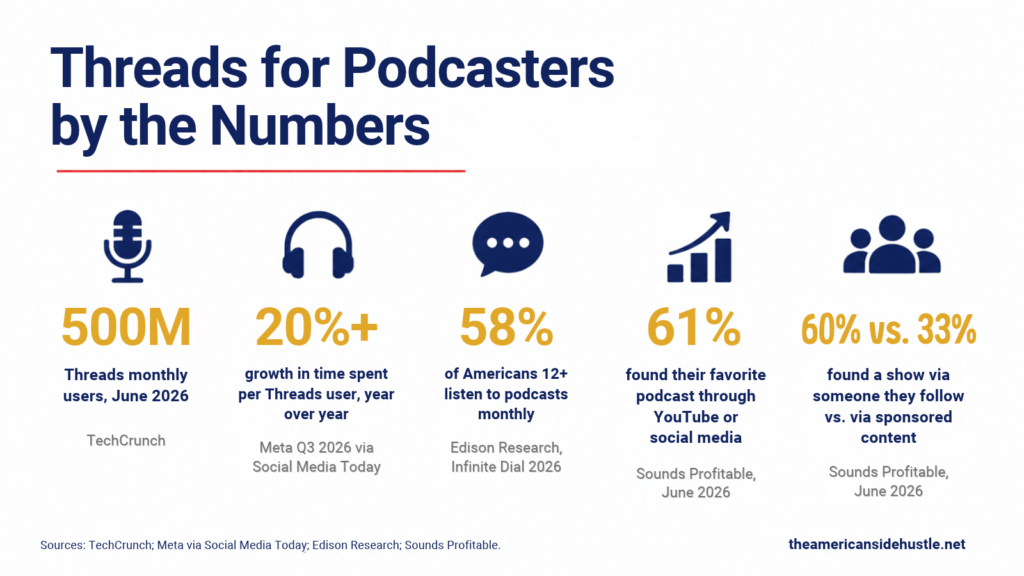
Threads hit about 500 million monthly users in June, adding roughly 100 million in 10 months, and pulled Communities out of beta, TechCrunch reported. Live Chats inside communities were expanding too. Hayes called them “a nice second screen companion experience for people that are watching stuff.” Then in Meta’s third-quarter results, CFO Susan Li said time spent per user on Threads grew more than 20% year over year, per Social Media Today.
One honest note on the U.S. picture: Pew’s latest fact sheet still shows Threads at 8% of American adults, from its 2025 survey, against 84% for YouTube, per Pew Research Center. Big globally. Still a smaller room here at home.
Listeners find shows through people, not apps
Podcast listening keeps hitting records. Edison Research’s Infinite Dial 2026 found 58% of Americans 12 and older listen monthly, about 167 million people, and 45% weekly, per the Edison release on Podnews. Some 57% have both listened to and watched a podcast. Edison’s Megan Lazovick put it well: “Video isn’t replacing podcast audio. It’s expanding the tent.”
And here’s the number that makes Threads interesting. In June, Sounds Profitable and JAR Podcast Solutions found that 61% of listeners discovered their favorite show through YouTube or social media. Among social discoverers, 60% found it through content from someone they follow, against 33% through sponsored content, per Sounds Profitable. Partner Tom Webster: “Podcasting has spent years optimizing for podcast apps while audience behavior has been shifting elsewhere.”
| Platform | Role for a podcaster | Key number (date) |
|---|---|---|
| Threads | Discovery and conversation: banners, link cards, transcript posts, Podcast Insights | About 500M monthly users (June 2026) |
| YouTube | Watching and discovery | 1B+ monthly podcast viewers (Jan. 2025); 40% found their favorite show there (June 2026) |
| Spotify | Listening and ad revenue | Partner Program: 1,000 engaged listeners, 2,000 hours, 3 episodes (Jan. 2026) |
| Podcasts overall (U.S.) | The audience you’re fishing in | 58% of Americans 12+ listen monthly (Mar. 2026) |
Sources: TechCrunch, YouTube, Sounds Profitable, Spotify, Edison Research.
Here’s my take on Threads for podcasters
Okay. Real talk.
Threads is not where your episodes get played. YouTube and Spotify are. Threads is where your show gets talked about. And according to that discovery research, talk from people you follow beats paid promotion almost two to one. That’s the job I’d give Threads. Nothing more, nothing less.
Now the skeptic part, because you deserve it. Threads users have a history of not clicking links. In July 2025, Chartbeat data showed Threads drove under 0.1% of sites’ referral traffic, compared with about 2% to 3% for Facebook, Engadget reported. Social media consultant Lia Haberman said, “People just got trained not to look for them, not to include them, not to think about them.” A Boston Globe executive said Threads was “trailing significantly in traffic, subscription conversions, and overall conversion rate.”
That’s old data, from before the podcast cards. But it tells you how to play this. Don’t lead with the link. Lead with the moment, and let the card do the selling underneath.
And here’s what genuinely excites me. Podcast Insights shows you clicks and saves. For years, podcasters guessed which social posts brought listeners. Now Threads will tell you, at least for its own traffic. That’s amazing for a small show, because you can stop posting on vibes.
One more thing. Meta’s announcement doesn’t mention paying podcasters anything. So the money still comes from your own channels: ads on Spotify or YouTube, sponsors, a paid community, a product. Threads is the top of the funnel. Treat it like that.
What you actually need (and what it costs)
The Threads side is free. Here’s the rest, with prices from official pages, checked today:
- An editor that makes clips and transcripts fast. Descript edits audio and video by editing the transcript. Per Descript’s pricing page, there’s a free plan with one media hour a month (720p, watermarked). Hobbyist runs $16 a month on annual billing or $24 month to month, with 10 media hours and tools like Create Clips and Remove Filler Words. Creator is $24 or $35 with 30 hours.
- A way to earn from listens. Spotify cut its Partner Program bar in January to 1,000 engaged listeners, 2,000 hours consumed in the last 30 days and three published episodes, per Spotify’s newsroom. Eligible shows get a 50% share of revenue from Spotify-monetized ads, and you need at least one ad break per episode, according to Spotify’s support page.
- An email list you own. Kit is free for up to 10,000 subscribers, per Kit’s pricing page. Creator is $39 a month, with a promo at $20 a month for the first three months that ends December 1.
- A home base for show notes. One of your five Threads profile links, which Threads has allowed since May 2025, per TechCrunch, should go to a show-notes page on your own domain. Hostinger WordPress hosting is where I’d put it.
Free Threads, free Kit, free or $16 Descript. You can run this whole system for the price of a couple of coffees a month.
How I’d play it
If I were launching or relaunching a show on Threads this week, here’s my order.
Step one: set up the profile like a show page. Add your podcast to your profile so the banner shows up. Use the episode picker to feature your single best episode, not your newest. Then use your five links wisely: listen link, YouTube link, email signup, show notes. Your bio says who the show is for in one line.
Step two: cut three moments from every episode. One strong opinion. One useful tip. One funny or surprising bit. Thirty to sixty seconds each. In Descript, that’s a matter of highlighting the transcript. These become your video and transcript posts. Remember, a lot of people scroll with the sound off, which is exactly why Threads built transcripts.
Step three: turn on reminders, and get your guest to turn them on too. When an episode premieres, you share the link card. Your guest gets the same nudge. Tag them in a guest card post and send them the exact clip you want them to share. Make it easy and most guests will do it.
Step four: start the conversation, don’t just announce. Instead of “New episode out now,” post the question your episode answers. “Should a first-time freelancer charge hourly or by project? My guest says neither.” Then put the link card in the post or a reply. Threads rewards replies, and a question gets replies.
Step five: find a Community and show up there. Threads Communities are out of beta. Find the one your listeners hang out in: true crime, sports, small business, whatever your niche is. Post useful clips there, answer questions, and host a Live Chat during a big moment in your niche. That “second screen” behavior Hayes described is perfect for a sports or TV recap show.
Step six: read Podcast Insights every Friday. Look at which posts got clicks and which got saves. Saves mean “I’ll listen later.” Clicks mean “I’m listening now.” Do more of what earns both. Drop what earns neither after three tries.
Step seven: move your best listeners to email. Once a week, offer something small: the guest’s resource list, a transcript of the best segment, a bonus episode. That’s how a Threads follower becomes a listener you can reach no matter what happens to the algorithm. If you want sponsors later, an email list and real listener numbers are what make that pitch work. I broke down the sponsor side in creator brand deals and their fine print.
Watch-outs
Don’t expect Threads to pay you. Nothing in Meta’s podcast announcement pays creators. Your income still comes from ad programs, sponsors and your own products.
Don’t count on every feature being in your app yet. Meta said these tools were rolling out “with more to come,” and the August transcription test came with no guarantee. Check your own app before you plan around a feature.
Don’t spam link cards. If every post is “new episode,” you’ve built an ad account, not a show. I’d keep it to one link post for every three or four posts that teach or entertain.
Disclose sponsors and affiliate links. The FTC says to disclose an affiliate relationship “both in the videos and in the description near the links,” and that “Paid link” right next to an affiliate link should be adequate, per its Endorsement Guides FAQ. That applies to your clips too.
Don’t build only on Threads. It’s a smaller share of U.S. adults than YouTube, and the link data has been rough. It’s one channel in a system, not the system.
Quick answers
Do I need video to use the new tools? No. Transcript posts exist so audio-only shows can share moments that read well without sound. Video clips help, though.
Is this worth it for a brand-new show? Yes, if you treat it as conversation. A new show has no audience to announce to. It needs people who find a moment interesting and follow you for more. If you’re thinking about a voice-led show built with AI tools, read my take on the AI voice side hustle first.
The bottom line
Threads finally treats podcasts like a first-class format: banners, link cards, transcript and guest posts, saves, reminders and its own podcast insights. The audience is big and spends more time there every quarter. The catch is that Threads people talk more than they click, and Meta isn’t paying anyone for episodes.
So play to that. Share your best moments, start real conversations, let your guests do half the promotion, and move your biggest fans to email.
Post the moment. Let the episode follow. That’s the play.
And when your show starts pulling in listeners, sponsors and email signups, you’ll want your funnels and follow-up in one place. That’s what we built at The American Side Hustle: landing pages, automated email and text follow-up, and text-to-pay. Earn in USD. Live anywhere.
Tools I’d use for this
- Descript: edit by transcript and pull clips for Threads in minutes, with a free plan to test it.
- Kit: a free email list up to 10,000 subscribers, so your Threads fans become listeners you can reach.
- Hostinger: affordable WordPress hosting for a show-notes site on your own domain.
Some of these are affiliate links. If you sign up through them we may earn a commission, at no extra cost to you. See all our picks on the Recommended Tools page.
Photos: John Taran, CoWomen and Zakhar Vozhdaienko on Pexels. Graphics: The American Side Hustle. Prices checked on official pages Nov. 25, 2026, and may change.
Ready to build your own American side hustle?
Get funnels, automated follow-up, text-to-pay and courses in one dashboard. Earn in USD, live anywhere.