It’s Saturday morning. Someone two miles from your shop opens TikTok and taps a tab called Local.
The first video is a bakery down the street pulling cinnamon rolls out of the oven. The second is a car detailer showing a before-and-after. Neither one has a big following. Both are close enough to visit by lunch.
That’s the shift. TikTok for local businesses used to mean hoping a video went viral somewhere far away. Now there’s a feed built to show your stuff to the people who can actually walk in.
Some links in this article are affiliate links. If you buy through them, we may earn a commission at no extra cost to you.
This one’s for you if you run a local side hustle, like a food truck, a lash studio, a cleaning service or a pop-up shop, or if you’re good on camera and want to get paid by the local businesses that aren’t. I went through TikTok’s own announcements on the Local Feed and TikTok GO, its holiday shopping numbers, its newest economic report, its ad and disclosure help pages, and the outside reporting that pokes holes in all of it. Here’s what’s real and how I’d play it this holiday stretch.




Remember this one line: Be the closest good answer.

Here’s what’s going on with TikTok for local businesses
Quick map first. If you want TikTok to pay you directly through Creator Rewards, gifts and subscriptions, I covered that in how to make money on TikTok right now. If you want to sell other people’s products for a commission, read TikTok Shop affiliate for beginners. This piece is about the other money on TikTok: real customers walking through a real door near you.
TikTok built a feed just for “near me”
On February 11, TikTok launched the Local Feed in the U.S., calling it “a new tab on the TikTok home screen designed to help people stay connected to their community.” It shows travel, events, restaurants, shopping, and posts from small businesses and local creators. TikTok says posts are picked by location, topic and how recently they were posted.
A few rules matter for you. It’s opt-in and off by default, and only for people 18 and up. According to TikTok’s announcement, videos from accounts under 18, private accounts, and posts set to Friends or Only You won’t show up there. And it rolls out gradually, so not everyone in your town has it yet.
The feed uses precise GPS location, and only while the app is open, TechCrunch reported. It first rolled out in December in parts of Europe, including the U.K., France, Italy and Germany. MacRumors noted that users have to turn on Precise Location to use it at all.
TikTok’s own numbers on local visits are big
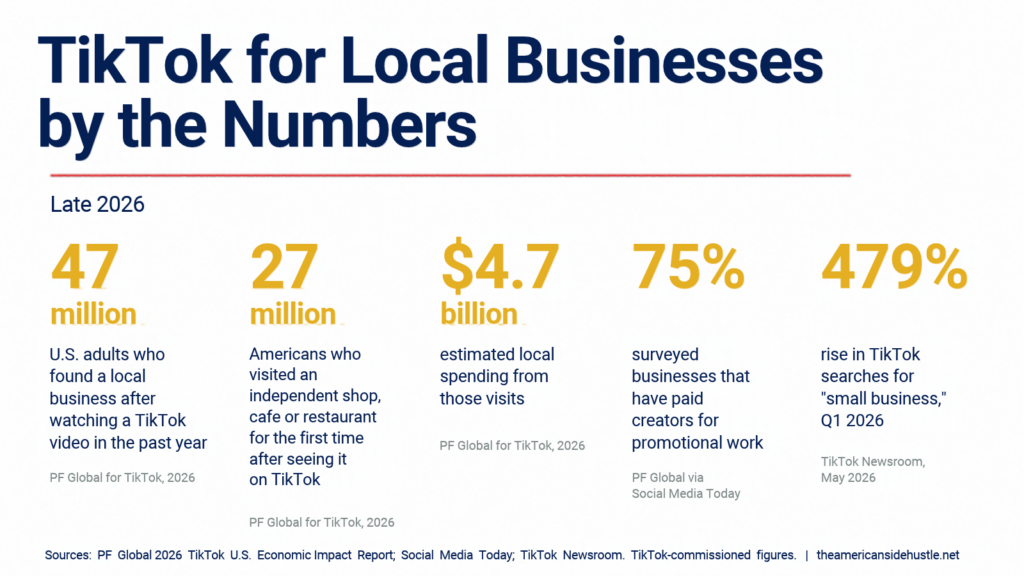
This fall, TikTok published its 2026 U.S. Economic Impact Report, produced by the research firm PF Global. The local numbers are the ones I care about. The report estimates that 47 million American adults found a local business after watching a TikTok video over the past year, and 27 million visited an independent shop, cafe or restaurant for the first time after seeing it on TikTok. It puts the local spending from those visits at $4.7 billion.
Neil Ross, a partner at PF Global, summed it up this way: “Our research shows that for many Americans, TikTok has become their digital front door to real world experiences.”
The business side of the survey is just as rosy. 93% of businesses said sales went up after promoting on TikTok, and 85% of restaurant and dining businesses said they sold out of a product after promoting it. Social Media Today added a detail from the same study that matters a lot for side hustlers: 75% of businesses said they’ve commissioned creators for paid promotional work. The study surveyed 11,123 U.S. adults and more than 5,000 businesses.
Earlier, when it launched the Local Feed, TikTok cited the Small Business & Entrepreneurship Council: 84% of TikTok small business users said the platform helped grow their business, and 74% said it helps them connect with their local community.
| Number | What it measures | Source |
|---|---|---|
| 47 million | U.S. adults who found a local business after watching a TikTok video in the past year | PF Global for TikTok, 2026 |
| 27 million | Americans who visited an independent shop, cafe or restaurant for the first time after seeing it on TikTok | PF Global for TikTok, 2026 |
| $4.7 billion | Estimated local spending from those visits | PF Global for TikTok, 2026 |
| 75% | Surveyed businesses that have paid creators for promotional work | PF Global via Social Media Today |
| 479% | Rise in TikTok searches for “small business,” Q1 2026 | TikTok Newsroom, May 2026 |
| 37% (65% ages 18-29) | U.S. adults who use TikTok | Pew Research Center, Oct. 2026 |
Sources: TikTok Newsroom, Social Media Today, TikTok Newsroom, Pew Research Center. The first five are TikTok-commissioned or TikTok-shared figures.
Small business is a search term now
In May, TikTok said searches for “small business” on the app rose 479% in the first quarter of 2026, in its Small Business Month post. One line from that post stuck with me. Abbey Kowalec, founder of Angel Baked NYC, said: “TikTok rewards businesses that show personality.”
On the shopping side, Modern Retail reported that TikTok Shop sales from U.S. small businesses (under $15 million in annual revenue) grew 66% in 2025, with more than 215,000 of them selling, up 25% year over year. Those figures were shared by TikTok, and TikTok doesn’t publish its sales publicly.
The holiday clock is running right now
TikTok Shop’s Black Friday and Cyber Monday campaign runs November 11 through November 30, Retail Brew reported, and U.S. LIVE shopping sales more than doubled in the first half of 2026. For a baseline, TikTok said last year’s four-day weekend topped $500 million in sales, and sellers who hosted livestreams saw 84% sales growth, per its December 2025 recap. Small Business Saturday lands in the middle of it, and I laid out that day in my Small Business Saturday 2026 playbook.
TikTok GO pays creators for local bookings
On May 12, TikTok launched TikTok GO in the U.S. It lets people find and book hotels, attractions and tours inside the app, through partners including Booking.com, Expedia, Viator and GetYourGuide. Creators who feature those places “can link their content to bookings” and earn through commissions and creator campaigns. Adam Presser, CEO of TikTok USDS Joint Venture, said: “TikTok GO connects that moment of inspiration directly to the businesses behind it.”
Creators reach it through the Monetization section of their account, and posts carry a note that the creator earns a commission, “for transparency,” Social Media Today reported. When the program first started as a limited test, creator analyst Lindsey Gamble described it as invite-only. TikTok hasn’t published commission rates, so check your own Monetization tab.
Here’s my take on TikTok for local businesses
Okay. Real talk.
Most of the big numbers above come from TikTok or from research TikTok paid for. Social Media Today’s Andrew Hutchinson called the headline economic figure “fairly speculative,” built on “estimates based on estimates.” I agree with him. Don’t plan your rent around 47 million anything.
But here’s why I still like this. Going viral for a local business was always a little useless. A bakery in Ohio with a million views from people in Texas sells… a few gift cards. The Local Feed flips that. It’s designed to show your video to people who can get to you. For a local side hustle, 300 views from your zip code can beat 30,000 from everywhere.
And look at that 75% figure again. Three out of four surveyed businesses have paid creators to promote them. Most local owners are too busy running the shop to film it. That’s a side hustle sitting in plain sight: be the person in town who makes the local businesses look good on TikTok. If that sounds like your lane, it pairs perfectly with the AI and automation services small businesses can’t set up themselves.
TikTok GO is the part I’m least excited about for most people, at least for now. It’s travel-heavy, the rates aren’t public, and access has been limited. If you live somewhere tourists visit, try it. Otherwise, the Local Feed and direct deals with businesses are the better play.
One more honest thing. The Local Feed only works on people who chose to share their precise location. TechCrunch’s Sarah Perez put it well: it’s “worth considering whether or not the value of a local feed is worth the privacy risk.” Some people will never turn it on. So treat it as a bonus channel, not your whole plan.

What you actually need (and what it costs)
The good news: you can start this for almost nothing. Prices from official pages, checked today:
- A TikTok account set up right: Free. A business account unlocks a one-tap map directions button for storefronts, a link in bio without needing 1,000 followers, lead forms and multi-user login, per Social Media Examiner. The trade-off: “Business accounts also lose access to commercial music licensing available to personal accounts.”
- A phone and an editor: The phone you have is fine. For captions, cuts and text overlays, I’d use CapCut.
- A place to send people: A simple site with your hours, menu or booking link. Here’s how to get one up on Hostinger without a developer.
- Paid reach, only if you want it: TikTok’s Ads Manager budget page (updated July 2026) says a daily campaign budget “must exceed $50” and an ad group budget “must exceed $20.” TikTok’s local advertising guide shows you can target by city, county or DMA region and schedule ads by hour or day. The in-app Promote button is another option; it shows you the price before you pay.
The real starting cost is your time. I wouldn’t touch ads until a few organic videos prove what works.
How I’d play it
If I were running a local side hustle today, or helping one, here’s the order I’d go in.
Step one: make your account eligible for the Local Feed. Public account, owner 18 or older, posts set to Everyone. That’s TikTok’s own rule list. Then open settings and turn on location for yourself, so you can see your own Local tab and what your competition is posting. Metricool points to Settings, then Privacy, then Location. Menus move, so check yours.
Step two: tell TikTok where you are, every time. Social Media Examiner’s guide, featuring TikTok strategist Keenya Kelly, gives four simple moves: use TikTok’s location suggestion, add one or two local hashtags within the five-hashtag limit, say your town out loud in the video, and put the location name on screen. Kelly’s example: when she posted about Sugar Land, a Houston suburb, with #SugarLand as the only hashtag, nearly every commenter lived there. That’s the whole idea.
Step three: film the thing only you can show. The oven door opening. The dirty carpet, then the clean one. The first customer at 7 a.m. Personality beats polish. Three to five short videos a week is plenty, and you can batch them on a slow afternoon in CapCut.
Step four: give every video a “say this at the counter” line. Kelly suggests a secret word or menu item tied to each video, because TikTok analytics don’t always show where foot traffic comes from. “Tell us ‘cinnamon’ and get a free coffee.” Now you know which video brought people in.
Step five: catch the people who don’t walk in yet. Some viewers will tap your link, call after hours, or ask a question in your DMs. Don’t let those die. Set up a missed-call text-back and a booking link, the same setup I walked through in how to automate missed calls, texts and booking. I’d build that in GoHighLevel.
Step six: if you’re the creator, sell a simple local package. Walk into three businesses you already love. Show them two videos you made about their place, for free. Then offer a monthly package: a set number of videos, posted with the location and the right tags. Put it in writing, and get paid before you post.
Step seven: disclose every paid post, twice. TikTok’s creator disclosure page says creators “must turn on the commercial content disclosure setting” when promoting a brand, product or service, and undisclosed posts may lose For You feed eligibility. But the FTC’s endorsement guide says platform tools aren’t enough on their own; the responsibility “rests with the influencer and the brand.” Use TikTok’s toggle and say “ad” or “paid partnership” in the video itself.
Watch-outs
Don’t switch to a business account without thinking. You get directions, lead forms and a link in bio, but you lose the commercial music licensing personal accounts have. And Keenya Kelly has advised some clients against switching because business accounts can reach fewer people, per Social Media Examiner. If you’re mostly a creator, stay a creator. If you’re a storefront or you sell on TikTok Shop, the business tools probably win.
Don’t tag locations you don’t serve. The same guide says non-local businesses should skip location tags unless they’re targeting a specific city. A location tag on every video can bring you the wrong audience.
Don’t trust the headline numbers. The PF Global report, the 479% search jump and the small business sales growth all come from TikTok or research it commissioned. Use them for direction, then track your own counter-word redemptions.
Don’t promise a business viral results. You can promise consistent, well-made, properly tagged videos. You can’t promise views. Write that into your package.
Quick answers
Do I need followers to show up in the Local Feed? TikTok hasn’t listed a follower minimum. Its stated rules are about age, privacy settings and location. Small accounts can show up.
Is TikTok big enough for my local market? Pew’s October 2026 fact sheet puts TikTok at 37% of U.S. adults and 65% of those 18 to 29. If your customers skew older, keep Facebook and Google in the mix.
The bottom line
TikTok for local businesses finally has a real feature behind it. The Local Feed puts nearby posts in front of nearby people. TikTok’s own research says millions of Americans visited a new local spot because of a video, and most surveyed businesses have paid creators to help. The numbers are TikTok’s, so I take them with a grain of salt. The opportunity still looks real to me.
Tag your town. Film what only you can show. Give people a word to say at the counter. Catch the leads that come in after hours. Or, if you’re the one good with a camera, go sell that service to the shops you already love.
Be the closest good answer. That’s the play.
And once those calls, DMs and bookings start coming in, you’ll want them handled in one place instead of five apps. That’s what we built at The American Side Hustle: automated follow-up, booking and text-to-pay, ready to go. Earn in USD. Live anywhere.
Tools I’d use for this
- CapCut: quick captions, cuts and on-screen location text for short local videos.
- GoHighLevel: missed-call text-back, booking and follow-up so TikTok leads don’t go cold.
- Hostinger: affordable hosting for a simple site with your hours, menu and booking link.
Some of these are affiliate links. If you sign up through them we may earn a commission, at no extra cost to you. See all our picks on the Recommended Tools page.
Photos: George Milton, Bảo Minh and Abdel Achkouk on Pexels. Graphics: The American Side Hustle. Prices checked on official pages Nov. 25, 2026, and may change.
Ready to build your own American side hustle?
Get funnels, automated follow-up, text-to-pay and courses in one dashboard. Earn in USD, live anywhere.